BLOG
BLOGMixing Diving and Drugs – NSAIDs Show Potential for DCS Treatment
Can Common Medications Like Ibuprofen Help Treat the Bends? What Divers Need to Know.
02 September 2025
Can Common Medications Like Ibuprofen Help Treat the Bends? What Divers Need to Know.
When divers get bent in remote locations the first thing they’ve been trained to do is provide oxygen and immediately evacuate to a hyperbaric chamber. This isn’t wrong, but it’s not always the only – or the best – option. While recompression and hyperbaric oxygen have become the standard of care for moderate and severe cases of decompression sickness (DCS), a growing body of evidence is showing promise for pharmacologic interventions in lieu of recompression for cases of mild DCS in remote areas. The definitive treatment for DCS being recompression, adjunctive (or supplementary) treatments have existed for decades in the form of oxygen and hydration protocols. What is less commonly recognized is the potential role of drugs either as primary treatments for DCS in remote areas, or as supplements to reduce the severity of symptoms during evacuation or minimize the number of recompression treatments a diver requires. These medications run a broad range of risk profiles and potential applications, but suffer from a lack of research and recognition. This is partially because their applications are limited, and partially because in most cases outcomes will be unchanged, with the adjunctive treatments being focused on minimizing symptoms or speeding recovery but not improving overall effect of treatment.
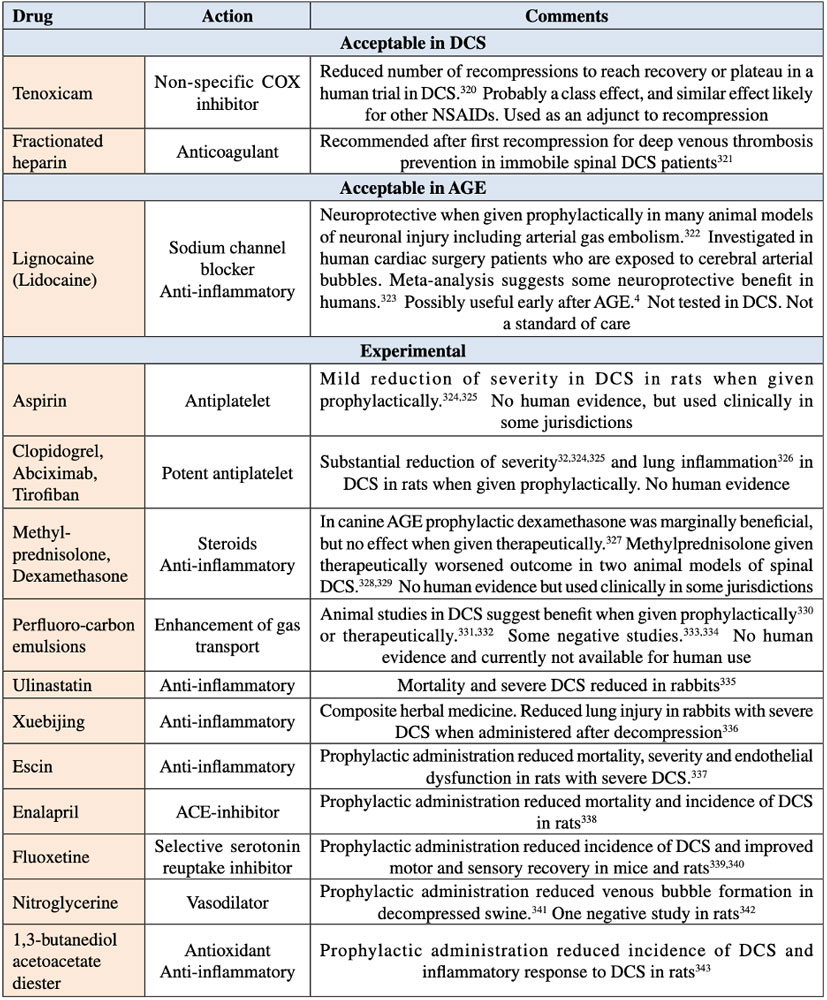
List of currently recommended adjunctive treatments and those still considered experimental. Source: Decompression Illness: A comprehensive review, by S.J. Mitchell, 2024. PMID: 38537300 (English only)
There’s been a renewed interest in both primary and adjunctive pharmacologic treatments for DCS in the past decade, largely driven by interest in a particularly strong paper on the use of a non-steroidal anti-inflammatory drug (NSAID) called Tenoxicam, first investigated in 2003 by Bennett, Mitchell, and Dominguez. Here’s what we know about NSAID use as a DCS treatment, and other adjunctive that show promise.
Adjunctive treatments for DCS have historically been investigated as supplements to oxygen on a long evacuation, or used during recompression therapy to accelerate recovery. Many of these treatments were theoretically sound but lacked data, leading to hugely variable applications between hyperbaric facilities. Following a 2003 study on the use of the non-steroidal anti-inflammatory drug (NSAID) Tenoxicam, interest boomed (if only relatively). The study was – and remains — the only randomized double blind trial of a medication to treat DCS, and its meticulous controls and large sample size made it an exceptionally strong base from which to build on. The strength of the study is also one of the reasons that oral NSAIDs are the only adjunctive treatment with strong enough evidence to support use by first responders caring for an injured diver in the field.
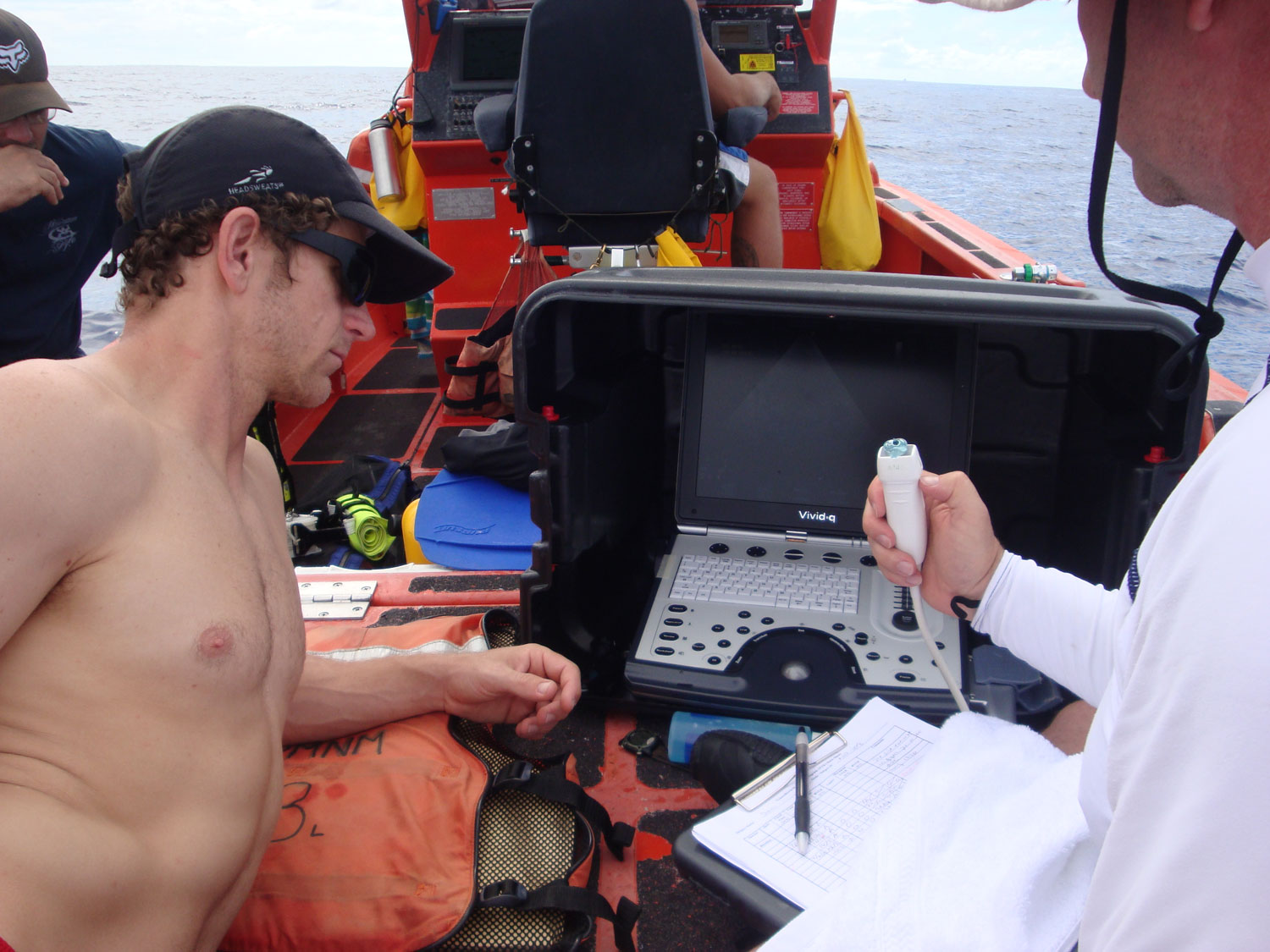
Neal Pollock conducting post-dive transthoracic echo (TTE) imaging on a deep science diver. The presence of bubbles in all four chambers of the heart is evaluated during rest and after directed limb movements.
Tenoxicam is no longer-acting NSAID than many of the over-the-counter medications most divers might be familiar with, but it shares a mechanism with common household drugs like ibuprofen and naproxen. The relatively benign medication was originally investigated as a supplement to recompression therapy, with the hope that its use could reduce the required number or duration of chamber rides a diver might need following a case of DCS. The study showed no difference in final outcome – divers who took the drug and divers who did not both achieved symptom resolution – but Tenoxicam did show a statistically significant improvement in the number of recompression treatments required to alleviate symptoms.
Hyperbaric physician and seminal expert in the field Dr. Simon Mitchell was involved in the original paper on Tenoxicam use and has investigated numerous adjunctive treatments for DCS in the two decades since. “It is likely the [improvement with Tenoxicam] is a class effect” contends Mitchell, adding that the drug was chosen for its long half-life but that other NSAIDs will most likely have a similar effect.
All of this does not mean that you can pack a bottle of aspirin instead of an emergency plan on your next remote expedition, but it provides a valuable tool to divers in remote locations. These drugs still need more human trials to prove efficacy and come to a consensus on protocols, but that research also gives us an opportunity to learn more about the still-theorized mechanisms of injury in DCS.
Mitchell suggests that cases of mild DCS “in a location where accessing a chamber would be difficult can be treated with first aid measures and a very strong expectation that recovery will be complete, if perhaps slower”. It’s important to note that this advice relies on the injury meeting the classification of mild DCS, and if a chamber is easily accessible it should still be used. It’s also important to clarify that cases of mild DCS will typically resolve without any treatment, which makes this a uniquely low-risk proposition that could significantly improve a diver’s recovery from DCS. Confirming that a case of mild DCS fits the criteria for this treatment protocol can involve a paradoxically longer diagnostic workup, and divers should be wary of both the time that workup may take and the possibility of missed or still evolving symptoms that might indicate a more serious case of DCS or arterial gas embolism (AGE) – both of which require prompt evacuation regardless of logistical difficulty.
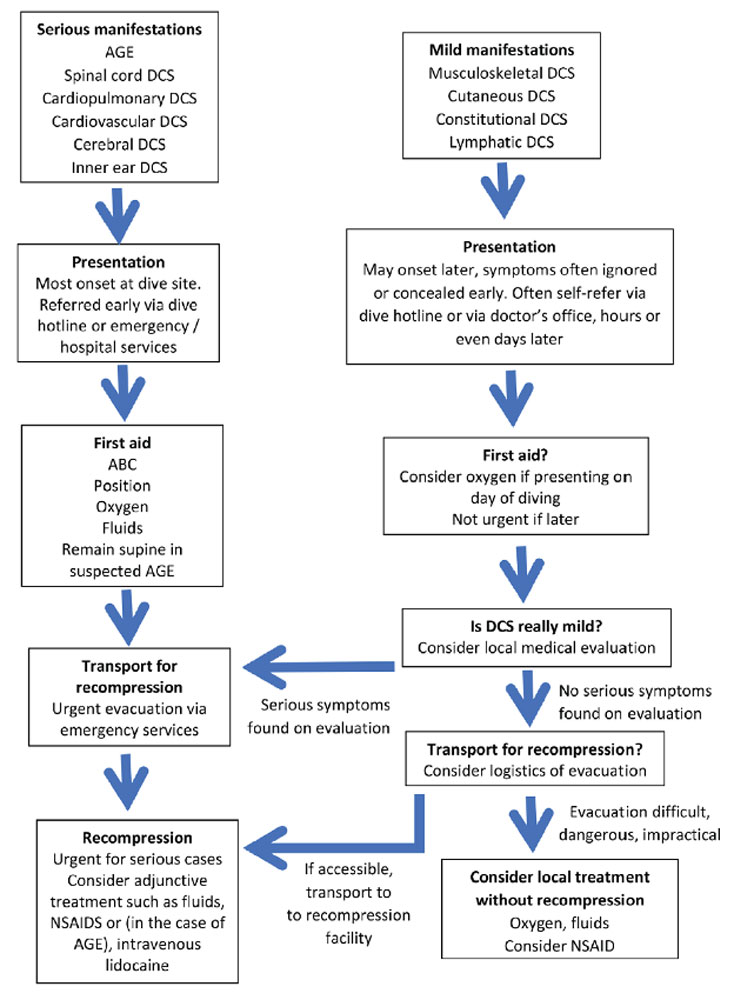
Illustrative clinical pathway for divers with AGE or DCS of serious or mild severity. Mild DCS cases may paradoxically involve more complex decisions about whether evacuation is justified as indicated. Source: Decompression Illness: A comprehensive review, by S.J. Mitchell, 2024. PMID: 38537300 (English only)
Research into other adjunctive treatments for DCS is still ongoing, and a definitive list can be found in the links below. Heparin, an anticoagulant often used for cardiovascular disorders, has shown significant promise, but others are still too experimental to recommend for use in any application – yet. It’s unlikely that one cure-all drug for DCS will ever be discovered, but this research has already changed the way divers in remote locations can be treated, and its continuation could be the secret to better understanding the mechanisms of DCS.
Important: in any diving emergency — or even if you merely suspect something might be wrong — it is essential to seek proper medical evaluation from specialists in diving medicine. Self-diagnosing or self-medicating can delay critical care and lead to worse outcomes. Call the DAN Emergency Hotline for immediate assessment and expert guidance.
The hotline is accessible to all divers, whilst DAN Members benefit from extended medical support, ongoing consultations, and comprehensive dive accident insurance that covers treatment costs when needed.
Your safety is always the priority — don’t take chances.
Works Cited:
About the author

Dive into the latest stories,
before anyone else.
Subscribe to the
Alert Diver
newsletter.