
Blizzard-Frozen: Polar Scientific Diving at -30 °C
18 June 2026

I learned to dive in German lakes and ponds during my early adolescence. Some years later, I was introduced to double tanks and technical diving during a year abroad at a dive center in Norway. After returning to Germany, I began specializing in marine science and combined my passion for diving and research by training as a scientific diver. I’m currently based in Kiel, a city on Germany’s Baltic Sea shore, studying greenhouse gases in various marine systems and supporting diving projects ranging from ocean alkalinity enhancement to archaeology. By most people’s standards, I am used to cold-water diving.
Having already experienced the harsh Arctic environment on Svalbard, Norway, during an ecology and toxicology course abroad, I believed I had a solid understanding of how to conduct scientific work in extreme conditions. However, the nine-day Polar Scientific Diving course at the Biological Station in Kilpisjärvi, northern Finland, run by the Finnish Scientific Diving Academy, was a completely different story. I had the opportunity to join thanks to GUE’s NextGen Traineeship.

Photo: Anni Malinen
Before the course began, we were introduced to human factors in diving and the concept of just culture: Individuals are not blamed for decisions or mistakes made within the limits of their experience, while willful violations are not tolerated. Over the course of the program, it became clear how essential this mindset is for the team. In stressful and demanding environments, mistakes are inevitable. What matters is finding solutions as a team and growing together, despite our diverse diving experiences and scientific backgrounds.
The first three days focused on preparation. Our instructors Edd Stockdale, Erik Wurz, and Pata Degerman walked us through everything we needed to know about operating in polar conditions: safety procedures, cold water rigging, communication with base, proper thermal protection (at least 3 layers, inner layer always wool), setting up camp (various options but kitchen tent on the perimeter because of hungry polar bears), hydration (at least 3 liters per day!), drilling and sawing ice holes (by hand), how to operate the snowmobile, tendering lines, and what to do in case of a free flow. The latter was a constant problem during the initial dives.

Photo: Pata Degerman
The days at the station were long, and at night we saw powerful northern lights over lake Kilpisjärvi. I couldn’t help myself but go skiing with equipment rented from the station while enjoying the breathtaking, dancing colors.
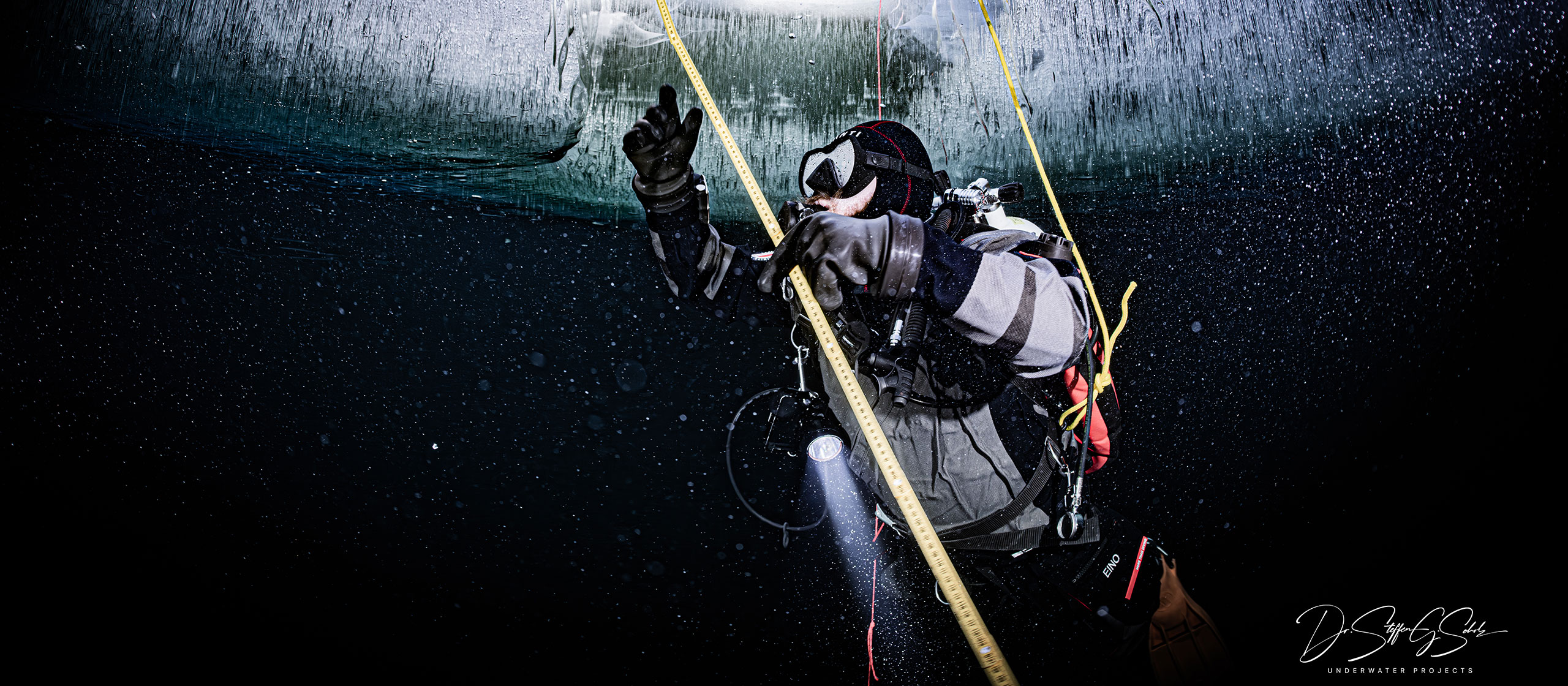
On day 4, we at last conducted our first check dive. The team was organized into clearly defined roles – supervisor, safety diver, tenders, divers – with members rotating from session to session. With air temperatures around -30 °C came logistical challenges: Each round, the non-divers had to defrost the holes and prep them with a safety line, stage cylinder, and tender lines. The dive gear was brought out at the latest possible moment, with tank valves closed and regs pressurized. The divers came last.
The situation felt surreal: I was in the middle of a pristine white landscape, looking down at a small, black, square hole in the meter-thick ice, into which I was preparing to jump willingly once the final checks were complete.

Photo: Pata Degerman
Breathing through the regulators at the surface was a no-go. Piston regulators in particular could start free-flowing just from opening the valves. The inflator could freeze as well, which made it impossible to operate the air inlet or outlet.
On my first dive, I struggled with a frozen inflator, then a free-flowing primary regulator, and finally a leak in my drysuit slowly flooding my undergarment. We tried our best to defrost the equipment with hot water at the surface, while divers patiently waited in the hole with regulators sumberged. However, on our first attempt, only one person out of eleven managed to conduct a proper dive. Fortunately, our performance improved over the duration of the course.

Photo: Pata Degerman
For me, the greatest challenge was to get underwater at the start of the dive so that the equipment could warm up in the water. To do so, I had to deflate my wing completely, exhale until I was submerged underneath the ice, and keep holding on to the safety line while slowly breathing from my primary.
I learned that when a second stage freezes, you will have plenty of time to close the valve, as long as you stop breathing through the system. The crystals blocking the second-stage piston (for example) are only beginning to form, and the gas flow increases gradually. The procedure is to switch to the backup, shut off the cylinder valve, and wait, hoping that your backup won’t freeze as well. Some divers leared the hard way that valve manipulation can be difficult when there is no air in your drysuit (left post closed).
When the primary first stage freezes, an interesting side effect happens: Besides bubbles coming from your second stage, the rising intermediate pressure will also cause your wing to self-inflate. Buoyancy control suddenly becomes very hard, and time is limited before you hit the surface – or a solid ice ceiling, in our case. The effect is similar to a frozen inflator button.

Photo: Pata Degerman
Another interesting aspect of working in -30 °C air temperature appears after the dive. Divers have to be quick to remove all their gear while seated. If you’re too slow, then a) the equipment freezes solid while still on your body or b) you freeze to the ground. After successfully removing their gear, the divers are transferred to a sledge and towed to the station with a snowmobile for defrosting.
To our luck, temperatures rose to a comparatively cozy -8 °C for the second half of the course, and with that the number of problems decreased drastically.
We had five diving days in total. Aside from getting our heads underwater, we conducted scientific tasks such as sediment core sampling, measuring the sediment thickness with a transect, and collecting ice samples from underwater. As the days passed by, we grew more comfortable as a team and adjusted to our daily routines. Everything started to click.
Being in a diverse group with people who had never dived with double cylinders before gave me a new appreciation for standardized diving equipment (DIR). It facilitated the pre-dive preparation and significantly improved work efficiency and emergency handling.

Photo: Steffen G. Scholz
Being exposed to the harsh climate while diving in cold water and trying to function effectively as a team was physically and mentally exhausting. I consumed three times my normal amount of calorie.s The delicious food at the station, combined with sauna evenings, definitely helped to keep our spirits up.
Our evenings were enriched further by presentations of the instructors’ passion projects. Erik captivated us with his cold-water sponge research in Antarctica, where 2-meter leopard seals could pop up in your diving hole out of convenience and curiosity. Tents over the diving holes make surface temperatures less of a problem there, but the water in Antarctica is even below 0 °C, and the ice sheet can be up to 3 meters thick.
Edd introduced us to his various cave and mine explorations in Finland at depths below 100 m, the joy of finding new passages, the work of installing deco habitats, and the process of deciding which movies not to watch while sitting through six hours of decompression.
Pata hooked us with stories about his diving and expedition guiding in the polar regions, including a crash landing in Antarctica and throwing salami as a distraction for polar bears in Greenland.

Photo: Anni Malinen
It was a truly enriching experience to be surrounded by so many inspiring personalities, including all of the participants. We had all worked on different projects in the past and experienced challenges with international operations and team members. It was amazing how strong we grew together in less than two weeks.
I also learned that the people who are most important for the team and success of an operation are not necessary the ones excelling in hard skills, but those that care deeply for other people. This was probably the most valuable lesson of the course. In such extreme conditions, there is no point in hiding who you are or trying to be somebody different. The best way to approach an expedition (and life) is to stay true to yourself, acknowledge your own limits and mistakes, and keep an eye on each individual’s needs.
Looking ahead, I hope to take part in more polar scientific diving expeditions in the future. In my opinion, courses such as the FSDA Polar Scientific Diving program are essential for learning the skills required to operate in remote and demanding environments, as well as to test your own limitations and reactions to stress. I would also suggest appointing a confidential contact person for each expedition, to give everyone the opportunity to speak up if they feel overwhelmed or unsafe. I very much appreciated the just culture approach and will try to implement it in future projects.
In addition to the team skills already mentioned, I picked up a number of technical skills for diving operations in very low temperatures and developed an intimate understanding of what can go wrong when a regulator free-flows. I became much more confident with my valve drills and handling challenging situations underwater.

Photo: Pata Degerman
I made connections and friendships for life during this course, and the problems encountered and solved during diving will help me in all my future projects. Beyond these personal achievements, I very much enjoyed the breathtaking location and the beauty of the ice, with so many frozen gas bubbles inside, which sparked my scientific interest in greenhouse gas production in freshwater lakes. My personal side quest was to reach the station with the lowest possible emissions, which resulted in one flight, eight buses, and one overnight train from Narvik via Kiruna to Stockholm – the iron transport route. Despite the longer journey I enjoyed meeting old and making new friends while traveling slowly.
I’m deeply grateful to GUE’s NextGen program and the Finnish Scientific Diving Academy for this opportunity. I will carry these lessons forward, and I wiill never forget that in the right conditions, even 1 °C water can feel like a spa.
FIND OUT MORE
Polar science diving – https://halifax.citynews.ca/2026/03/27/scientists-train-to-dive-beneath-polar-ice-as-climate-change-warms-the-arctic-and-antarctica/
About the author

Dive into the latest stories,
before anyone else.
Subscribe to the
Alert Diver
newsletter.