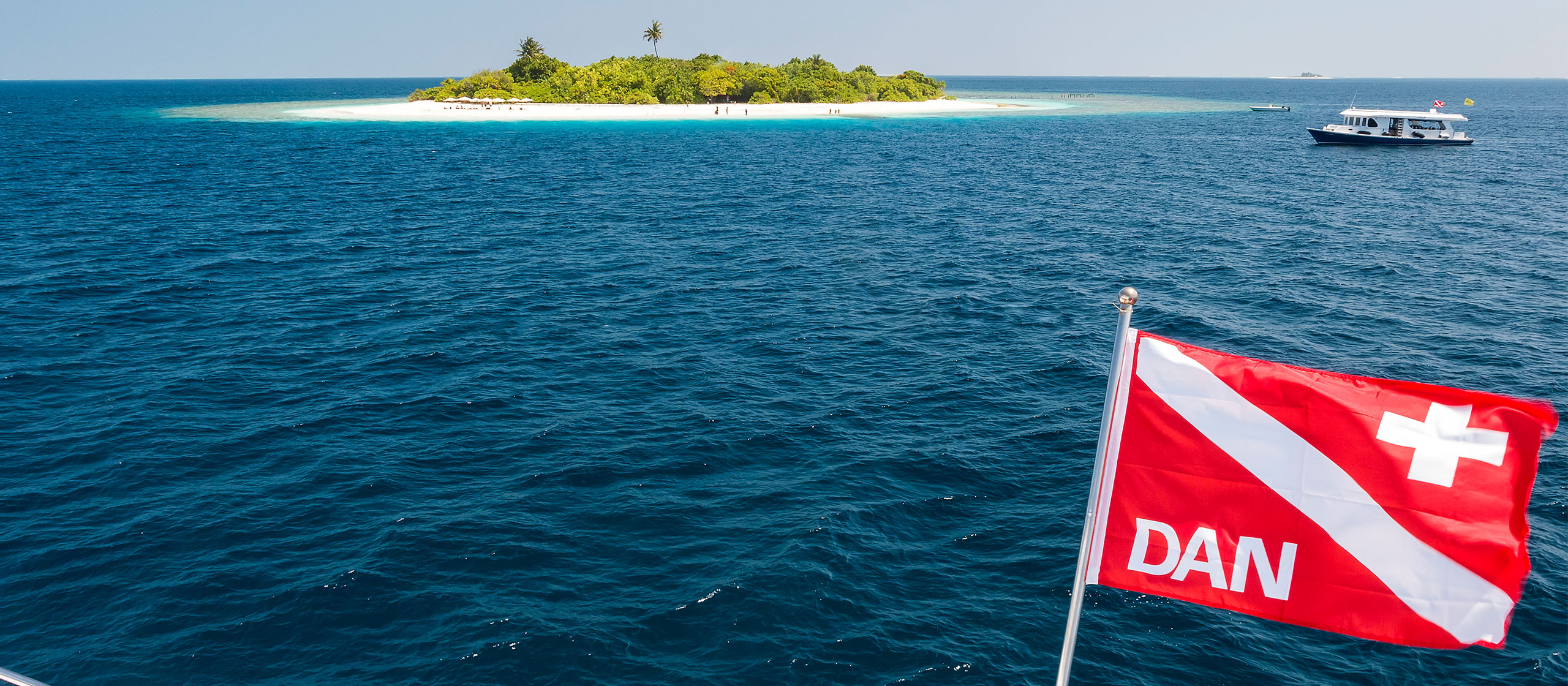
The support provided by DAN Europe through the complex recovery mission for the missing divers off the atoll of Vaavu in the Maldives builds on more than two decades of cooperation between the diving safety organisation and the government of the Maldives. Projects to enrich each other’s knowledge and know-how began to take shape in the very early 2000s. DAN Europe experts shared best practices in first aid and diving medicine, as well as the difficult aftermaths when victims are recovered. In return, the Maldivian authorities facilitated the work of DAN Europe scientists, allowing them to use the Indian Ocean atolls as a field for real-world experimentation to help make diving safer.
Now more than ever, we want to look back at how the cooperation with the Maldives has strengthened over the last 25 years, from diving safety training to the development of telemedicine for divers in remote locations.
Building the foundations: 2001–2005
The partnership between DAN Europe and the Maldives took its first formal shape in 2001, when a Diving Safety Day was organised in collaboration with the Maldivian government at Bandos Resort, one of the archipelago’s oldest dive resorts and home to the country’s first hyperbaric chamber. Medical, paramedical, and rescue personnel received training in safety principles and oxygen-assisted first aid, while DAN field research protocols were introduced to local operators for the first time.

Four years later, the relationship was tested under the most difficult of circumstances. In the aftermath of the 2004 Indian Ocean tsunami, DAN Europe (through the Claudius Obermaier Fund and in collaboration with DAN Southern Africa) funded the international forensic medical team responsible for identifying bodies washed ashore across the Maldives. Using Interpol’s Disaster Victim Identification protocols, the team examined 180 of 205 recovered bodies across 92 islands in 25 days, submitting all post-mortem data to the Interpol database. Among the Maldivian casualties, bodies from as far as Indonesia and Europe could be identified through dental records and secondary characteristics.
A decade of research in the field: 2011–2019
As the partnership matured, the Maldives became a key field location for DAN Europe’s Diving Safety Laboratory to conduct specific physiology research programs. Two landmark research programmes unfolded across these years. The Flying After Diving project used Indian Ocean dive conditions and in-flight cardiac echo monitoring to establish evidence-based guidelines on safe intervals between a diver’s last dive and their return flight.

During the same period, the first telemedicine systems were developed and field-tested: the objective was to enable real-time transmission of physiological data from an immersed diver to DAN Europe’s alarm centre, with bidirectional communication between the diver and remote medical staff. It led to the creation of the DANA health system to monitor scuba divers in remote locations.
Both programmes were conducted within formal agreements with local organisations, ensuring full compliance with Maldivian requirements. In return, DAN Europe continued to strengthen its safety network on the ground, building relationships with national emergency forces and both public and private healthcare facilities.
Strengthening the network: November 2023
In November 2023, a DAN Europe delegation conducted an official visit across multiple atolls, meeting chamber operators, diving doctors, resort managers, and hospital administrators. All five hyperbaric facilities in the Maldives were assessed: from the multi-chamber on Kuredu Island, Lhaviyani Atoll, to the two newly operational mono-chambers at ADK Hospital in Malé, which had treated an average of two diving cases per month since opening in February of that year. Presentations for dive centre professionals were held in Malé and at the Kuredu Island Resort, drawing questions on insurance, emergency protocols, and the logistical challenges of evacuating injured divers from the country’s more remote southern atolls.

The visit culminated in a meeting with the Minister of Tourism, during which DAN Europe made proposals to update the national diving regulations and offered collaborative training for government hospital staff on managing decompression illnesses.
Over the last 10 years, DAN Europe has handled 818 diving accidents in the Maldives. As these years include the pandemic, which disrupted the travel and scuba diving industries, the figures show sharp increases and decreases. Still, overall, the percentage of accidents and their evolution are representative of the trend DAN Europe case managers have observed globally since 2016. As the Maldives are growing in popularity with European divers, DAN Europe managed 149 diving emergencies from there last year. This is the highest number of cases for this country in the past decade.

 BLOG
BLOG