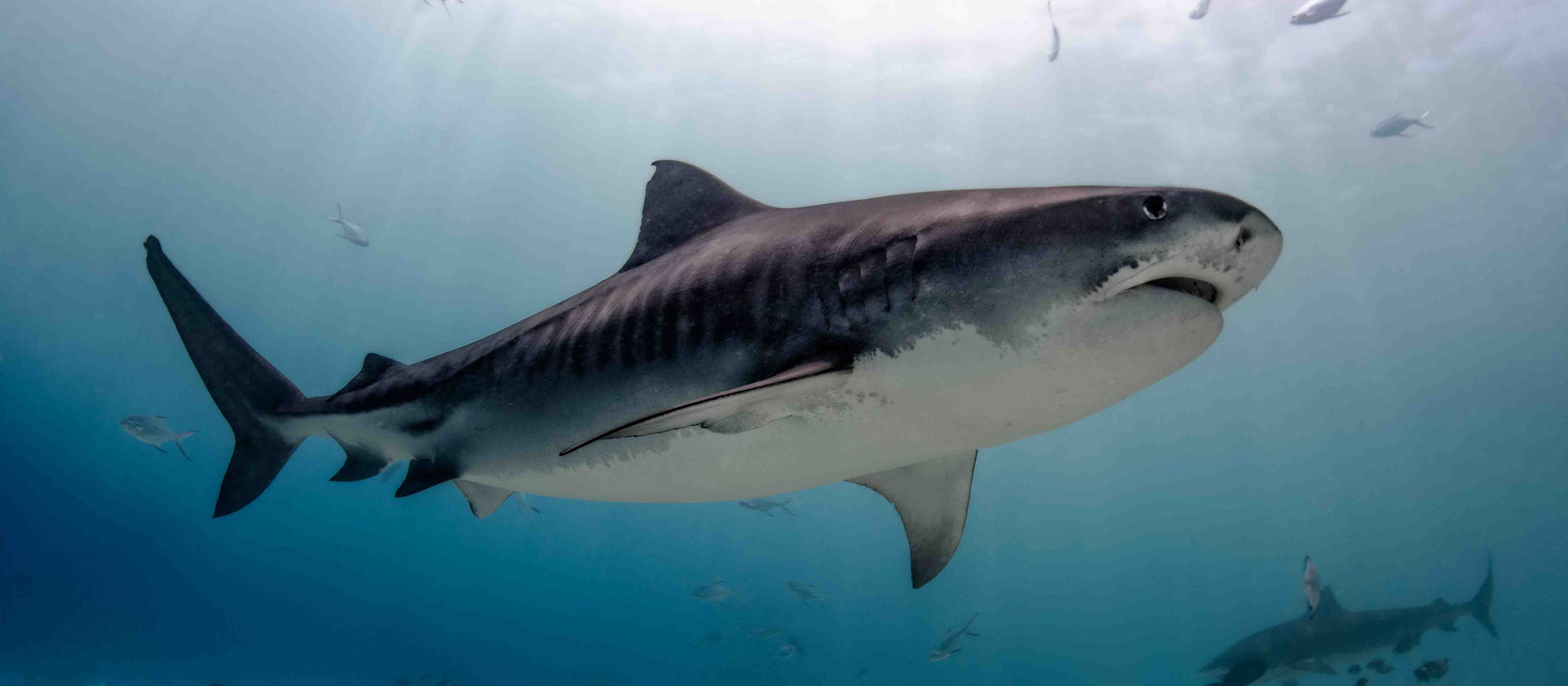
Alarming news about an alleged increase in shark attacks is circulating on the news outlets and social media. From the Egyptian Red Sea to Australia and the USA, shark attacks seem on the rise. Eric Clua and Andreas Dellios, two eminent researchers in shark behaviour and valued DAN members, shared their findings and recommendations with us.
All experts I consulted agree on one point: the lack of a comprehensive, updated database. The best tools we currently have are the ISAF (International Shark Attack File) and the GSAF (Global Shark Attack File), run by the Florida Museum and the Princeton-based Research Institute, respectively.
According to the ISAF and the GSAF, the number of lethal shark attacks has doubled in 2025, compared to historical data. From an average of 6-7 per year, deadly shark attacks went up to 12 in 2025. As before, the two leading countries are the US and Australia. Both countries share an enviable feature: tens of thousands of kilometres of coastlines, largely suitable for swimming, surfing, diving, kayaking, and any type of marine activity you could list.
However, the Red and the Mediterranean seas also have long coastlines. Despite millions of people in the water all year round, shark attacks are almost nonexistent in the Mediterranean Seacomparison to the Red Sea. This difference has a cause: Shark populations in the Mediterranean have declined dramatically.
Reality or Perception?
Eric Clua and Andreas Dellios, both DAN members, agreed to explore the issue for Alert Diver’s readers. Eric is a veterinarian who later became a marine ecologist and an eco-anthropologist with solid experience in marine conservation and marine environment governance. In his academic career, he lists a position as director at the prestigious EPHE (École Pratique des Hautes Etudes). He is also a prominent researcher of shark behaviour and shark attacks.
Andreas Dellios is the president of the renowned SharkSchool based in Eleuthera, Bahamas. Andreas (Andy) is a researcher, dive guide, and filmmaker with a huge number of shark encounters and interactions in his logbook. Andy co-authored papers with the late Dr Erich Ritter, the founder of SharkSchool and a true pioneer of the field.
Eric Clua
“Shark attacks may have increased with the increasing number of sea users in specific areas around the world. New sports that favour interactions between humans and sharks (kite surfing, wing foil, jet ski) have entered the scene. As far as I know, there are no climate change drivers. And yes, the main problem is public perception, driven by social media”
Andy Dellios shares Eric’s view on social media resonance:
“In my opinion, the increase in shark attacks is part of a false perception. Since we’ve had social media, everything gets posted multiple times or kicked off in the infosphere”.
Are we shark food?
As divers, we are used to pointing out ‘insane’ and unprofessional shark feeding practices (chumming), spearfishing, lack of knowledge about shark behaviour and the mishandling of sharks as the motivation for shark attacks. We perceive sharks as scavengers that would feed on us only after our death.
In 2024, HEPCA (Hurghada Environment Protection and Conservation Association) reported one case of ‘abnormal shark behaviour’. The HEPCA investigation into the killing of a snorkeller by a tiger shark in Dream Beach, Hurghada, in 2023, resurrected old beliefs: The shark had killed the snorkeller to feed on him.
Following several shark attacks, two of which were deadly, a HEPCA statement gave “wrongful human behaviour, such as overfishing, waste disposal into the sea, excessive use of natural resources, and failure to manage resources in a sustainable manner” as possible causes.
Let’s make one thing clear: These practices, including overfishing, are not directly prompting sharks to switch to human prey. Instead, certain human practices negatively impact shark habitats. Sharks in turn might respond by venturing outside their usual feeding area to find food.
Andy Dellios largely agrees:
“All accidents with sharks are provoked by us or are caused by third parties. For example, take swimming in an area where fishing takes place upstream: This creates are several motivations for biting, such as curiosity, stress, competition, or provocation – intentional or not.
At SharkSchool, we rule out hunger as a motivation. If an accident occurs, a combination of factors such as overfishing, noise, hectic activity, fishing/spearfishing, etc. plays a fundamental role. Accident analyses help us to avoid such mistakes. This protects both us humans and the sharks.”
Eric Clua points out the increase in sea users:
“While the depletion of marine fauna due to overfishing is a very indirect cause, the increasing number of people in the water is a direct cause. Shark feeding practices are responsible for some instinctive and clumsy bites, mostly non-fatal. Fatal attacks are something else that we need to understand in order to prevent it.”
Strange behaviour or bad attitude?
In 2010 and 2011, Sharm el-Sheikh made global headlines. A female oceanic white tip killed or mutilated several unfortunate tourists right in front of their hotels. She, the oceanic white tip, had a deformity on her tail fin.
The Sinai Governorate started a shark culling campaign that killed a mako and many other sharks, but the female oceanic white tip is probably still on the run.
Many years later, in 2023, a tiger shark fed on a human victim near Hurghada. The shark, again, showed a deformity. In this case, on its dorsal fin. HEPCA and many marine scientists agree that sharks with a physical impairment may resort to hunting in shallow waters, or well away from their usual feeding paths or usual prey.
Eric Clua went deeper into the matter and authored a number of papers and studies. “HEPCA is promoting my hypothesis of ‘problematic sharks’, which is wise.”
Eric cited a study from 2014: Shark personalities? Repeatability of social network traits in a widely distributed predatory fish. In this paper, David M. P. Jacoby et al. find that certain sharks can become bolder and keen to attack or even feed on humans. Based on these findings, a 2018 paper by Eric Clua and Dennis Reid argues that certain sharks need to be profiled. A short explanation is posted on Eric Clua’s website:
“In crime science, profiling consists of characterising, and if possible, identifying individually, the person responsible for a murder. This approach can be applied to sharks, essentially in the context of fatal bites on humans. Indeed, the police will not waste time profiling an individual who has broken into a car; they will concentrate on serious cases involving one or more crimes. In the same way, it is unjustified to profile a shark that has superficially bitten a sea user.”
Eric Clua supports the idea that a highly selective removal of the ‘missbehaving sharks’ is a better alternative to current practices of indiscriminately fishing for sharks to reduce the risk of bites on humans, such as in Reunion or New Caledonia (French overseas territories).
Debunking myths and misconceptions.
Apex predators are not pets. On social media, animals like sharks and lions are too often portrayed as friendly to humans. On the other hand, sharks are not even close to being as dangerous to people as other predators.
Scientists and experts agree: Incident statistics clearly show that the likelihood of being bitten by a shark is extremely low.
Divers used to believe that a shark attacks on surfers occur because a sharks can mistake surfer for a seal or sea lion. This could of course happen. In ‘The ‘Mistaken Identity Hypothesis’ for shark bites on humans is an anthropomorphic fallacy’ however, Eric Clua (with Carl Meyer) refutes this widespread notion as a mere assumption without solid scientific proof.
“Yes, they are wild predators and should be respected as such. They may not be as dangerous as initially thought, but one needs to remain prudent. I am totally against influencers that present sharks as sweet puppies.” – Eric Clua
Another piece of bad news: Many divers are aware of the typical ‘warning dance.’ In some cases however, sharks would attack without warning.
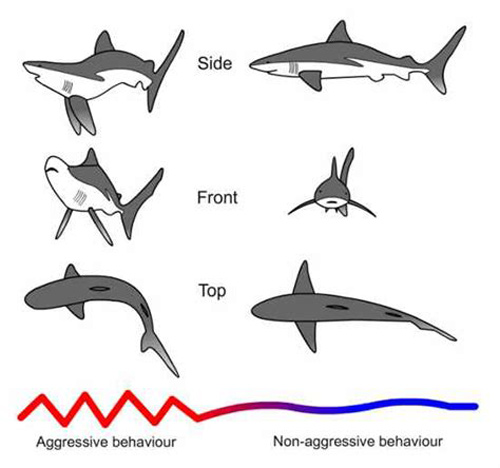
To date, as Eric Clua states in this paper published by frontiers.org, there is no consensus on what motivates sharks to bite humans. Some authors support the triggering role of environmental factors, while others (like Clua himself) instead focus on individual differences in personality.
In the same paper, Clua shows that certain types of shark bite can be associated with human activities, such as spearfishing or collecting prey from fish traps, which induce defensive behaviour in sharks. A diver – and more likely a spearfishing skin-diver – can be perceived by a shark as a danger or rival in certain conditions.
Fishing and spearfishing are thought to be the main driving factors that encourage a shark to bite.
Andy Dellios explains how captured fish release stress hormones and bodily fluids in the water. “When a human is in this smell corridor, the shark may show interest in the human. It will not mistake one of us for a fish, but it may still be encouraged to examine the human more closely, which could lead to a test bite. We don’t believe in dangerous sharks – only dangerous situations. As already mentioned, these are caused by our own intentional or unintentional misconduct.”
How to recognise and avoid dangerous situations.
Since there is no scientific consensus on the specific factors leading a shark to bite a human, it is worth furrher exploring the scenarios in which bites take place. You probably won’t like the first one: The only shark bite assessed by the DAN Emergencies Department as ‘probably provoked’ involved a diver trying to free an entangled shark.
Eric Clua is very clear on that issue:
“I don’t approve of the approach to classifying shark attacks taken by ISAF and GSAF. Both focus on so-called ‘unprovoked’ attacks, which is an anthropocentric concept. There is always a reason or a motivation for a bite, and it isn’t necessarily linked to human activities. This said, an untrained person should never attempt to free a shark from entanglement or remove a hook stuck in a shark’s mouth.”
As divers, we love sharks and care for their well-being. Unfortunately, we cannot handle them as if they were pets. After all, vets sometimes sedate even puppies and kittens, for purposes as mundane as claw trimming.
Here is a list of human-induced or environmental conditions we should avoid in areas where sharks are active.
As divers
- Murky waters
- Spearfishing areas, areas with fish traps
- Areas where dead fish or other animal wastes are dumped
- Irresponsible/unprofessional shark feeding
- Threatening sharks or obstructing their paths
- Diving alone
As non-divers
All of the above, plus:
- Making noise
- Not wearing fins
All the above conditions have been listed by experts as potentially contributing to the (still extremely low) likelihood of a shark attack.
How to avoid unpleasant interactions.
Experts and databases all agree that being bitten by a shark extremely rare on it. Unfortunately, extremely rare doesn’t mean impossible.
Andy Dellios has some advice to share with us. In his experience, the briefing is key:
“Whether you’re swimming, diving, snorkelling or surfing: Always ask for a briefing. We need to know what to expect in the water.
Rules of conduct when a shark appears are: Return to the group, stay together and remain calm, maintain a vertical position, and always look at the shark. We apply the Face-Guide-Push-Move (F-G-P-M) rules.
There is a reason for letting the legs hang down: Legs are the source of propulsion, and a shark will investigate them more closely. When hunting, this top predator aims to disable the prey’s propulsion in order to avoid wasting energy. When you are in a vertical position, you can always turn with the shark.
As a general rule, never hit the shark. Try to let it pass by. In extreme cases, you can push water against the shark’s gills. If the animal remains nearby, swimming towards the shark may help, as this reduces the animal’s angle of approach. The shark will feel compelled to return to a comfortable distance.
Our shark-human interaction training courses are based on 35 years of research and experience by one of the former leading scientists in shark-human interaction, Dr Erich Ritter.”
Eric Clua suggests acting more boldly.
“Face the shark and be bold. Punch it if gets dangerously close.”
Even though Eric’s and Andy’s suggestions differ a little, it is worth noting from where the suggestions come from: Scientific consensus takes a lot of time and effort to form.
Regarding Eric’s advice, I watched plenty of footage from underwater videographers – they were, of course, diving alone – repelling shark attacks by pushing their camera housings on tiger and lesser sharks’ noses.
Regardless of whose suggestions you want to follow, one thing appears quite clear: Doing nothing is the wrong move.
Here is a list of what to do if a shark gets too close and, in the unlikely event, it tries to bite.
- Always face the shark (eye contact)
- Punch or redirect the shark
- Stay together (buddy or group)
- Maintain a vertical position.
- Stay calm.
Surviving a shark attack.
While most shark attacks result only in a single bite, shark sometimes return to the victim. This was the case in the 2024 Marsa Alam incident, in which a swimmer was fatally attacked by a tiger shark. A friend intervened, punching the shark repeatedly and causing it to flee. Sadly, this was too late for the victim, who subsequently died from blood loss. This is a tragic story. However, it contains some valuable lessons for dealing with shark attacks.
Eric Clua
“When an active buddy is present, the shark can be made to desist from the attack and flee. Since the majority of deaths from shark bites are due to blood loss, having a tourniquet on hand is extremely useful. A weightbelt can also work, ideally a rubber one.”
Andy Dellios has something to add about removing an injured person from the water.
“Only pull a bitten person out of the water if you can do it in one go. Otherwise, the shark might come back to assert its claim of ownership, which could result in multiple additional bites. The only exception is if the victim is in danger of drowning.”
DAN Europe’s observations.
From 2017 to 2020, DAN Europe’s Emergency Hotline didn’t have to deal with any cases of shark-related injuries. Between 2021 and 2024, the hotline received six calls for emergency assistance involving sharks – out of 10.376 requests in total. None of the six cases resulted in a fatality, and there was no case in 2025.
These numbers hardly justify calling the recent rise in shark-related injuries a crisis.
Sleep well, divers.
In-Depth
https://www.researchgate.net/publication/385653242_First_Evidence_of_Individual_Sharks_Involved_in_Multiple_Predatory_Bites_on_People
Accueil – ENGLISH

 BLOG