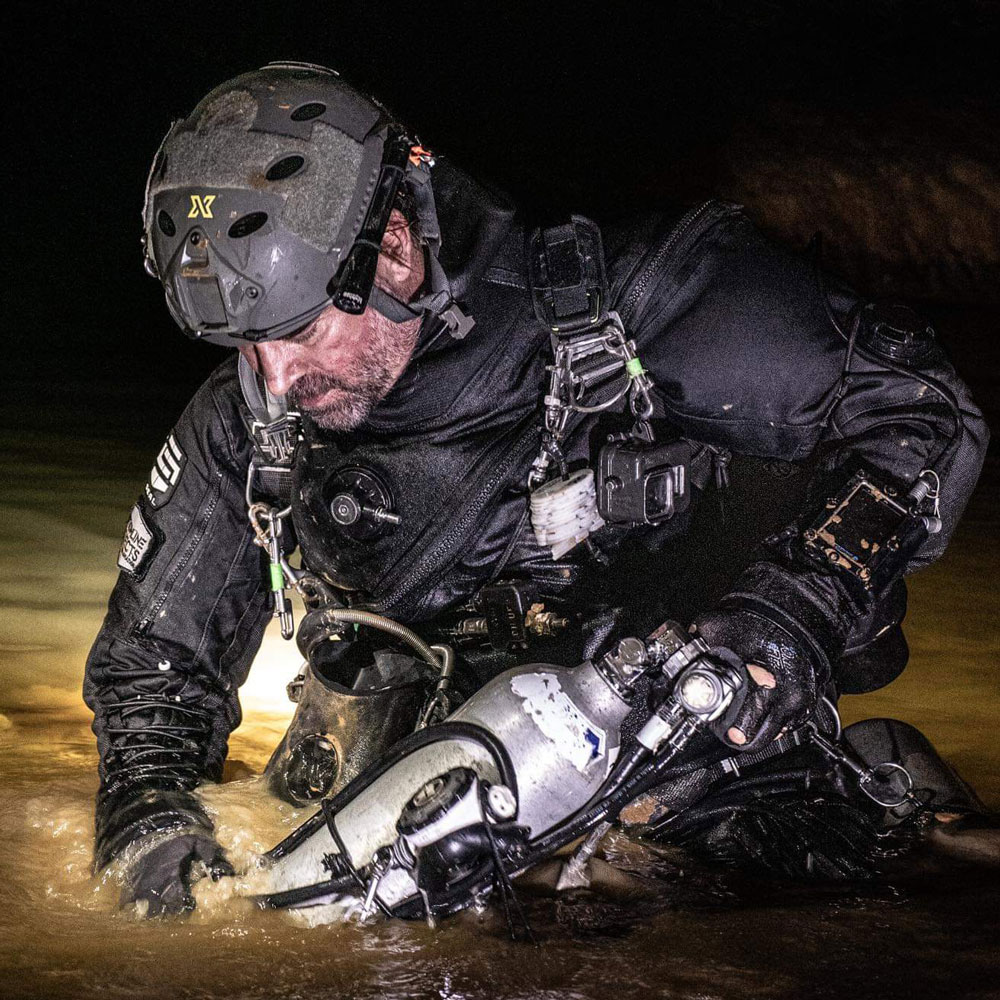
We didn’t go to Laos looking for a rescue.
Our connection with Laos mine rescue began years earlier, through flooded-mine exploration in Thailand. I had spent years working in overhead environments, where you cannot simply swim to the surface if something goes wrong. Flooded mines present their own challenges: unstable structures, abandoned equipment, fine sediment, unpredictable passages and, in some cases, dangerous water or gas conditions.
Exploring these mines was about more than reaching the end of a passage. It was about understanding how the environment behaved, recognising its hazards and developing procedures that allowed us to operate more safely.
Over time, I wanted to turn that experience into something useful for other divers. I introduced mine-diving and training in Thailand, focusing on the realities of flooded mines rather than treating them simply as another form of cave diving.
In a mine, good buoyancy and propulsion are not enough. Divers must understand how easily movement can destroy visibility, how to navigate three-dimensionally, how to manage restrictions and collapse hazards, how to detect possible toxins and how to respond when the exit is no longer immediately accessible. They must also recognise when conditions exceed their capabilities and when the correct decision is to turn around.
Exploration gave me experience. Training gave me a way to pass that experience on. Both helped build the foundation for what happened in Laos.
Three expeditions that built the bridge
Before the emergency in 2026, I had organised three cave-diving expeditions in Laos under Bottomline Projects NGO flowing the foot steps of a seasoned dry caver, Liviu Valenas. These were exploration missions, not rescue exercises. We wanted to understand unfamiliar underground environments, develop local connections and build experience in a country where cave diving was still relatively new.
The three expeditions took place before the rescue operation, during the period when we were developing our knowledge of Laos and building relationships with local people. I do not want to invent exact expedition dates or details that have not been properly documented, but their importance is clear in the timeline of what followed: exploration came first, the rescue came later, and the relationships created during those expeditions made the rapid response possible.
One of the most important outcomes was my relationship with Alex Souliyakane, the only Lao diver I knew personally.
On May 22nd when I saw a report that seven people were trapped underground, I contacted Alex in the middle of the night. He understood the language, could communicate with people at the site and helped us obtain information that would otherwise have been difficult to gather quickly.
That connection was crucial.
The previous expeditions had not taught us exactly what we would encounter at the mine. They had given us something more fundamental: a starting point. We had local contacts, an existing relationship and a reason to believe we could build a response quickly.
The Thai mine-diving work had developed practical experience. The training had helped structure and share that knowledge. The Laos expeditions had built local familiarity and trust. When the emergency came, all three strands came together.
None of them alone would have been enough.
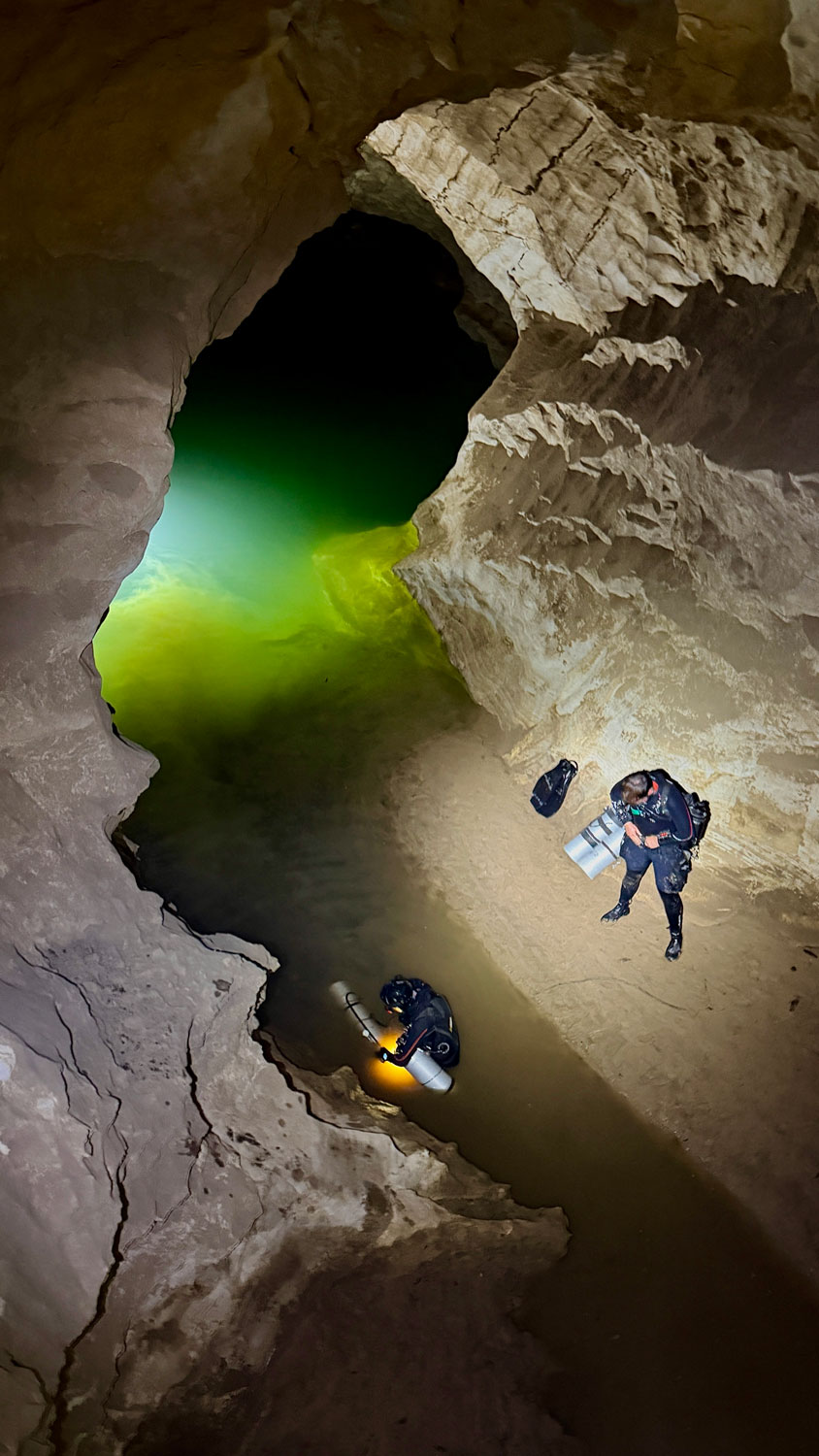
Bottomline Projects team surveying a new section of Tham Khai Nau in Laos. Every day exploring Lao cave systems gave us vital information for the actual search and rescue few months later. Photo: Mikko Paasi
The timeline begins
The rescue operation began on 20 May 2026, after reports emerged that seven people were trapped underground in Laos.
The exact information was unclear at first. We did not know the full layout of the mine, the condition of the people underground, the distance to the flooded sections or whether the reported distances were accurate.
The first stage was therefore not simply travelling to Laos. It was establishing reliable communication, understanding the situation and determining whether a rescue response was possible.
The call
The information coming out of Laos was confusing. Seven people were reportedly trapped behind flooded tunnels in what was being described as a gold mine.
I have been involved in cave rescues before, so I knew immediately that the difference between seven people trapped underground and seven people who might still be alive underground was enormous.
The first thing a rescue needs is information.
At around 2:30 a.m. on 22nd of May, I contacted Alex. He called me back an hour or two later. Through him, we began receiving information directly from Laos.
At the same time, I began making calls. DAN Europe became involved, and we started working on logistics, permissions and possible team members. Reaction time is critical, but you also need to understand what you are reacting to.
Nobody knew exactly what was down there. The distances being reported ranged from around 100 metres to a kilometre. Nobody could accurately describe the entrance or tell us how much of the system was flooded.
So we went in with incomplete information.
That is always dangerous.
DAN Europe: Support from the first day
One of the first calls I made was to Divers Alert Network (DAN) Europe. I knew that assembling a team for an operation like this would require more than finding capable divers. We needed support, coordination and help navigating the practical challenges of getting an international team to Laos quickly.
Laura Marroni at DAN Europe was immediately supportive. She made it clear that DAN would support us if we could assemble a team and establish that we could help on site. That initial commitment gave the operation an important push at a time when information was limited and every hour mattered.
DAN Europe’s contribution was an important part of that network. It helped turn an urgent call for help into a coordinated response and demonstrated why specialist organisations and established support networks matter long before the outcome of a rescue is known.
Travelling to the mine
On 23rd of May, I had established the initial team, Alex Souliyakane, Norrased Palasin and my self, Por Parasu Komaradat stayed in Bangkok coordinating from distance while the rest of us began the journey to the site.
I had to take a ferry and three flights to meet the team at Udon Thani airport and then spent around nine hours driving roughly 250 kilometres because the roads were so bad. We lost tyres, crossed flooded and muddy roads and eventually had to find alternative routes.
This was not a straightforward approach to a known cave entrance. We were travelling into a remote mountainous area with limited information, difficult roads and no certainty about what we would find.
Then we still weren’t at the cave.
We followed a guide with a Kalashnikov rifle through the jungle and up the mountainside before finding the entrance—or, more accurately, a hole. It was about half the size of my body.
Laos was not Tham Luang
People naturally compared the operation with Tham Luang. I understood why. In 2018, I had been involved in the rescue of the Wild Boars in Thailand, so when people heard “Mikko Paasi”, “flooded cave” and “people trapped underground”, they immediately thought of that rescue.
But Laos was completely different.
At Tham Luang, there is a large natural entrance, big chambers and space to move equipment. In Laos, we arrived in the middle of nowhere.
The entrance looked more like a natural cave that somebody had tried to enlarge by digging. That made it extremely unstable.
The first ten metres already contained a serious restriction. Then another. And another. Eventually there were approximately 200 metres of continuous squeezing, with only a couple of places where you could turn around.
I remember looking at one of the first restrictions and thinking:
There is no way I can get through that.
Then I went through it.
And it just kept going.
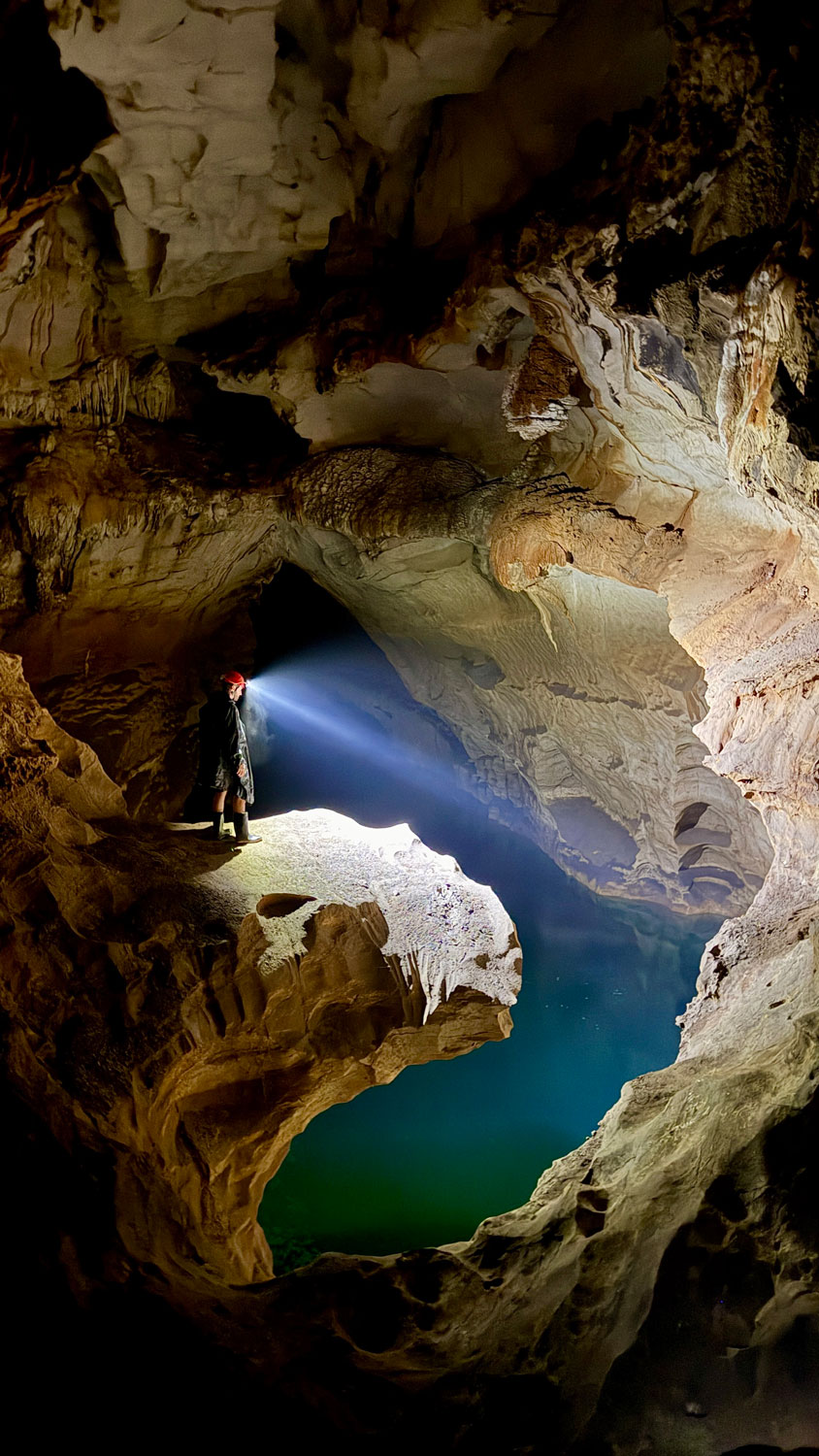
Robin Cuesta assessing conditions at Tham Dan Makhia, the deepest sump so far in Laos at 79m. Having previous experience on Lao cave systems proved to be helpful during the rescue operation. Photo: Mikko Paasi
Reaching chamber five
Since our arrival to the site on the 24 May we had been crawling in and out the 300 metre partially flooded tunnel to the chamber four where the submerged part started. The men where blieved to be past that flooded restriction in the chamber 5.
To get past the restriction between 4 and 5 took us three days. To get all the dive gear through the first 300 squeeze was a task it self. Each crawl took 55 minutes one way and because of the size of the tunnel, you could only bring one item with you.
In the whole mine, there was no room for more than maximum 5 to 6 people in at the same time. Everything needed to be well synchronised to avoid bottle neck effect where two people meet in the middle of the restriction where the nearest place to turn could be 50m away.
Also the volume of the whole mine was so small that the air quality dropped immediately and we were relying on poor ventilation and some medical oxygen tanks. In case of a rain fall the tunnels would flood in a matter of minutes and we would have no chance to crawl out.
It took us 3 days negotiate the way from chamber four to chamber five. We couldn’t just push in without a plan. Gradually we made our way deeper through the continuous squeeze, we dug it wider at some choke points and installed a guide rope, not only for us to get through but for the potential underwater extraction.
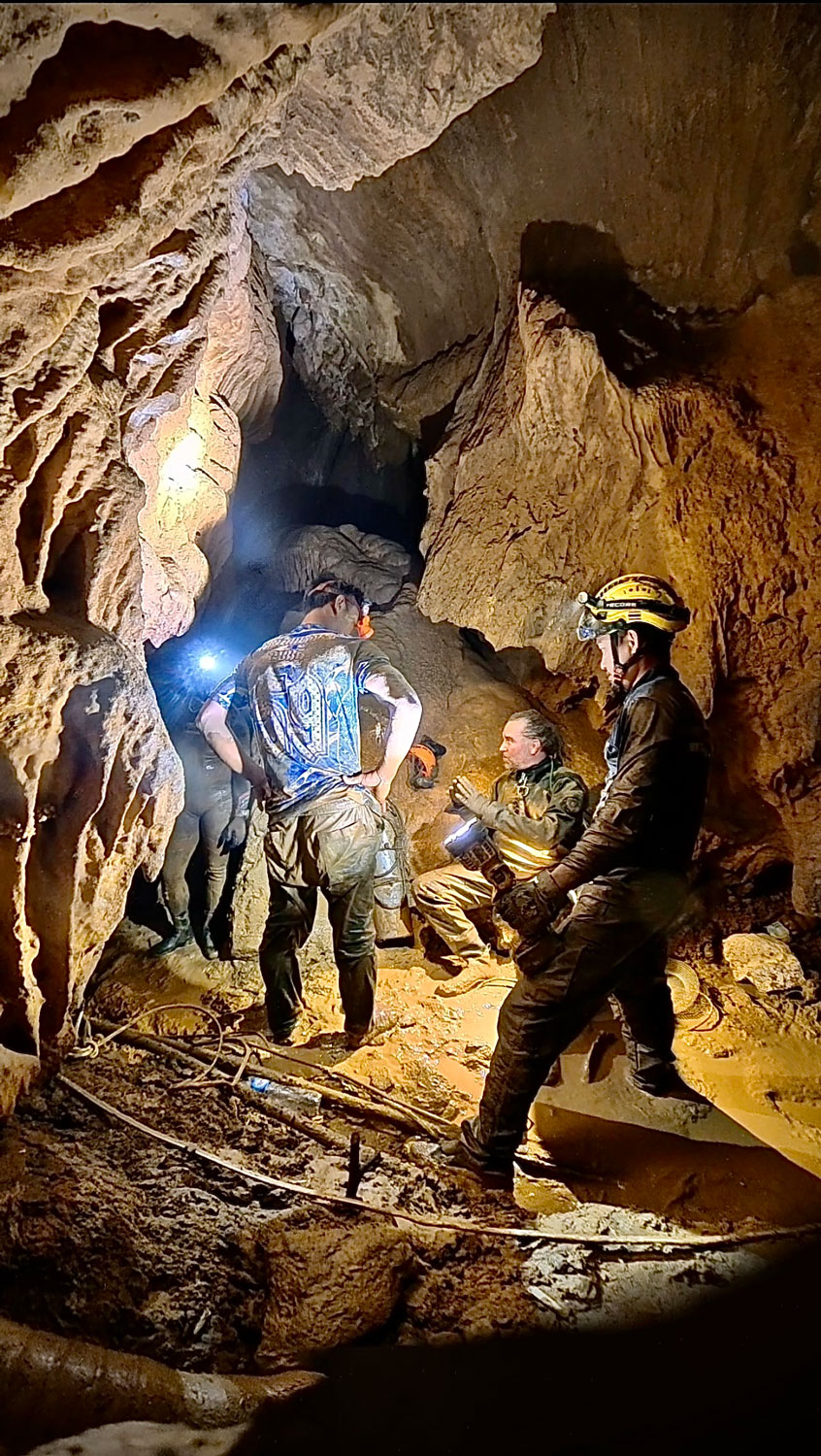
Chamber four, the last dry chamber before and where the actual diving started. This was the only chamber where you could stand up and it took an hour to crawl in through the main tunnel. Photo: Bottomline Projects archive
We had to go through every single scenario to be ready what ever situation was waiting for us on the other side. Group of miners sealed in a small place for over a week could turn out to a trap for 7 composing bodies blocking the tunnel or some men still alive but paranoid armed with spades and pickaxe’s. One thing was sure, they could not imagine two foreign divers emerging from the dark waters.
The final push dive was done without fins or sidemount system as there was no room and we needed to move feet first feeling our way forward with tip toes and to avoid being trapped.
On 27th May, the seventh day after the men became trapped, we finally reached chamber five, where they were sheltering. The whole situation changed.
We found five men alive.
They were grey and pale from being underground for so long, but they were alive. They were smiling. There were tears and huge smiles from both sides.
The first thing we realised was that there were only five of them? We asked for the remaining two but none of the miners had seen them and had no recollection there being any more than their group of five.
Regardless, I remember thinking:
We haven’t rescued them yet. We’ve only found them.
That distinction was important.
Finding someone alive in a cave is not the same as getting them out.
We gave the men the little life support we had with us and dove out to chamber four to collect the survival packs we had prepared earlier just to find out that the local miners, who helped us carry equipment, ate them all the night before. It was becoming a long day in the mine as we had to wait for new packs to arrive from outside.
The news about the missing five spread out fast via wi-fi that had been now installed all the way to the last dry chamber.
From 27th May onward, we monitored their vital signs, hydration, core temperature, strength and mental condition. We used letters and video messages to maintain their hope and help them understand that people outside were working to reach them.
But finding them was only the beginning of the rescue phase.
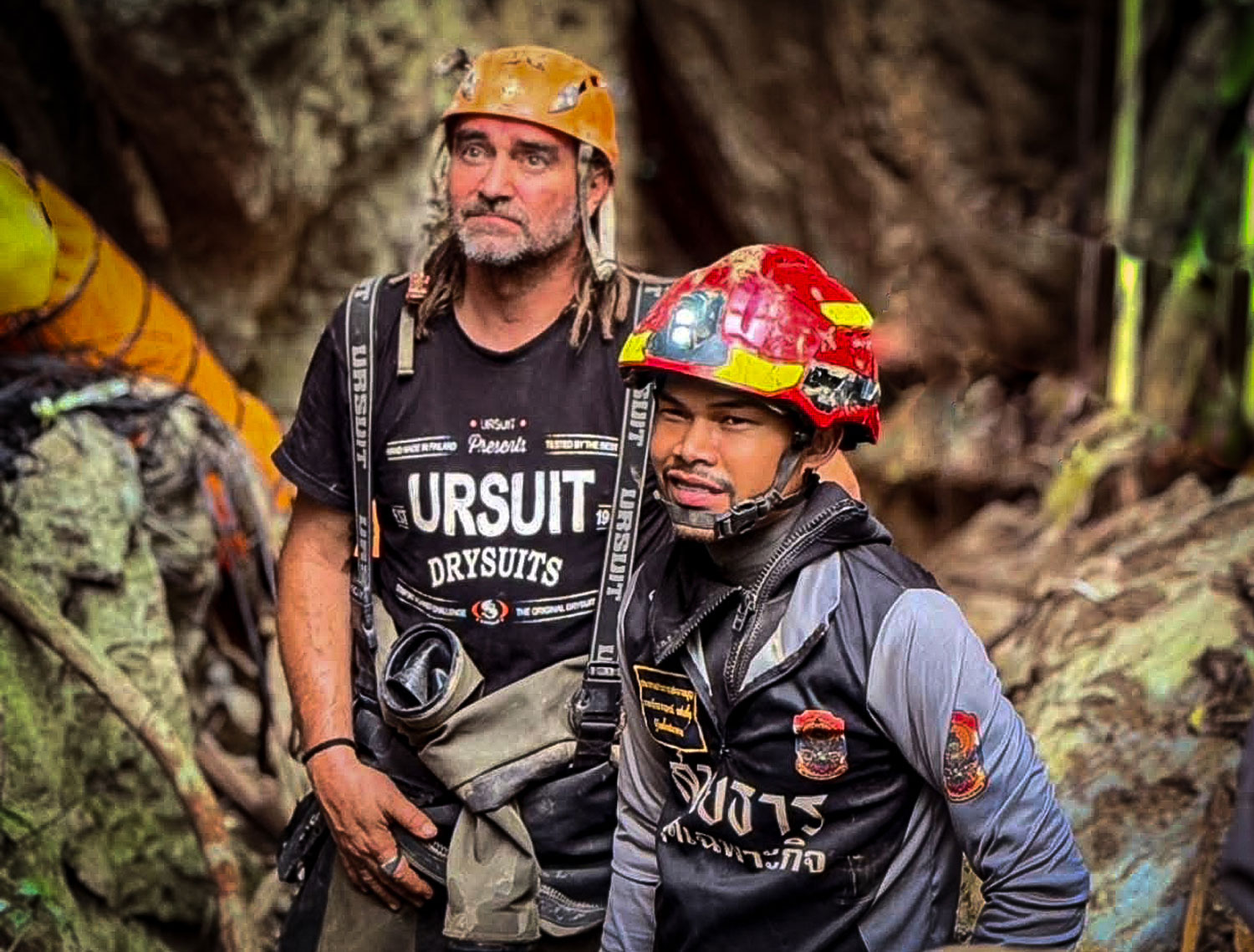
“Those who say it can’t be done, shouldn’t interrupt people doing it” – Another example of the power of unity and how we can move mountains when we work together for a common goal. Photo: Bottomline Projects archive
The conditions underground
Everything for the rescue, compressors, generators, massive commercial pumps, dive gear etc. had to be carried through kilometres of thick mountain jungle. Eventually the locals build a road over the mountain and established wi-fi connection all the way to the fourth chamber. These two additions became one of the key elements to successfully extract the men inside.
The environment was extremely difficult. In some sections, we had to move using only fingertips and toes. There were places where I had to exhale to make my body small enough to pass.
There was no room for normal cave-diving equipment. I removed my wing, did not use fins or a computer, and handled the tanks almost as separate objects rather than wearing them in a conventional configuration.
If something went wrong, we were hundreds of metres underground, behind a series of restrictions, with almost no room to help another person.
The experience from Thai mine exploration and training became directly relevant here. We already understood that the flooded section was only one part of the problem. The dry passages, restrictions, equipment handling, visibility, communications and changing water levels could be just as dangerous.
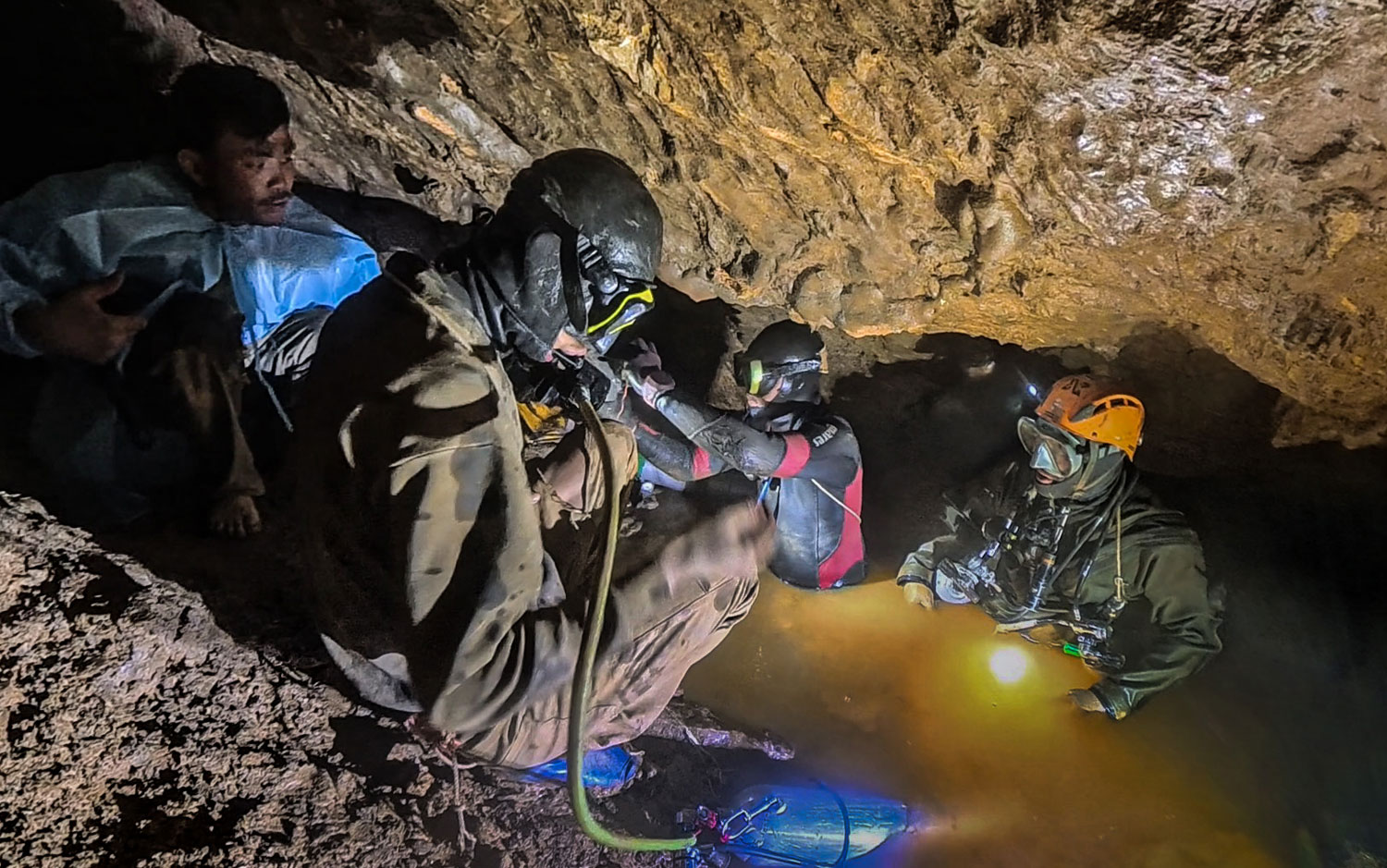
The passages were so tight that we could not use classic sidemount configuration but had to make our own from rope and dive without fins. Photo: Mikko Paasi
Pumping was always Plan A
My preferred rescue solution was simple: pump the water out.
If we could lower the water level enough, the men could crawl out themselves. That would be far safer than transporting a person through the restrictions underwater.
But the pumps were unreliable. Water levels changed, rain came and equipment broke. We needed a backup plan.
At that point, only two of us—the Thai diver called Benz and I—were capable of diving at the end of the system. We needed more people, but I wasn’t looking for famous divers. I needed people I trusted, people small enough to fit and people comfortable with extreme cave exploration and dry caving.
That became the international team we called the Filthy Few: Robin Questa, Audita Harsono, Josh Richards, Narunchit Kiatmaneesri, Lee Kian Lie, Panattha Saekhio and Yoshitaka Isaji. We all knew each other through Bottomline Projects.
The name was partly a joke.
The requirements were not.
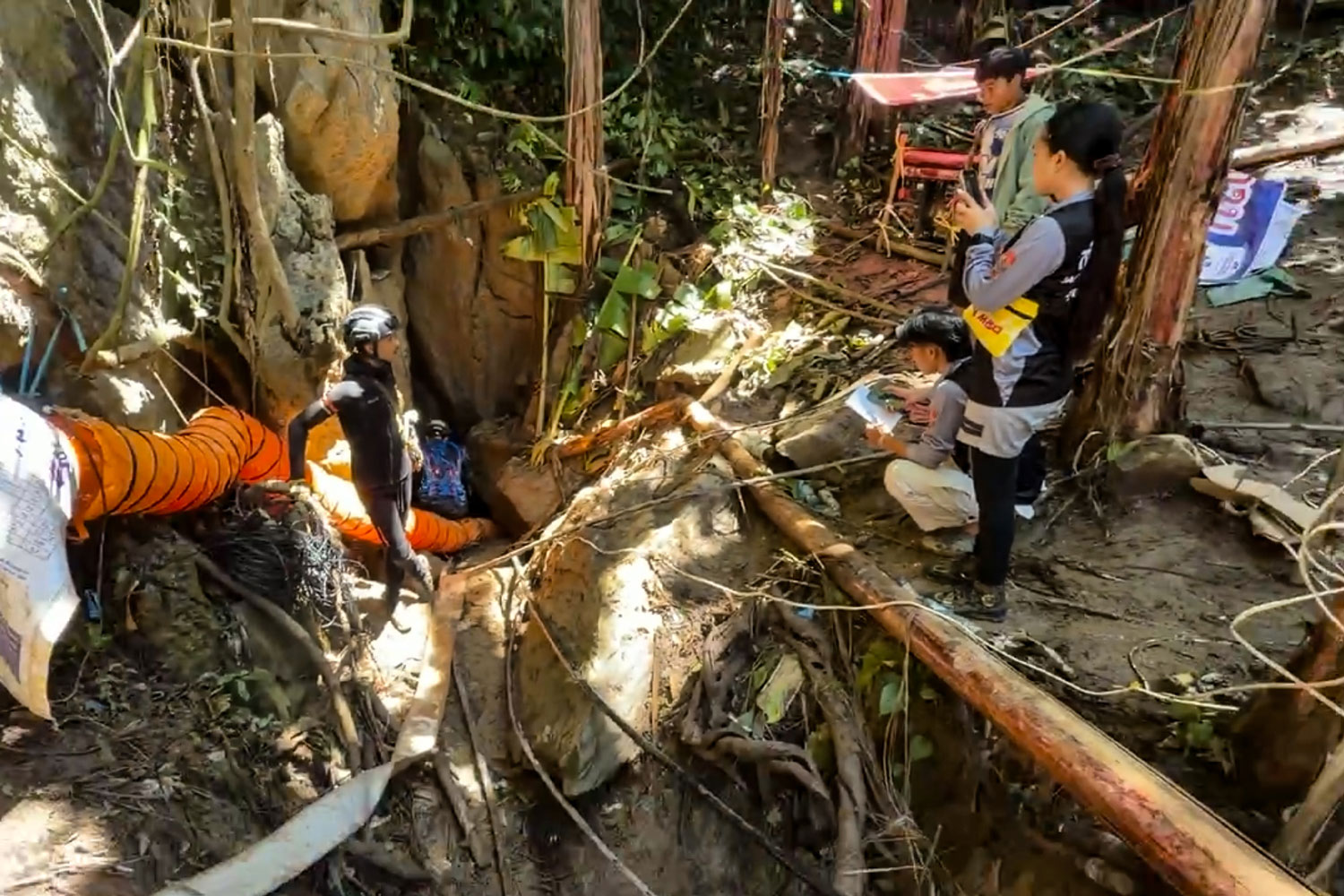
The entrance to the mine was more like a hole in the ground size of a car tyre. Thai rescue team was monitoring the entry/exit to control the scheduling. Photo: Mikko Paasi
One man out
After we had found the men and spent time monitoring their condition, the situation deteriorated enough that we had to consider an underwater extraction.
This was not what I wanted. It was not a technique I considered safely repeatable. But we had to make a decision.
The first man was brought through the flooded restriction on 29th May, including a roughly 30-metre-long continuous major restriction between chambers five and four.
I remember the moment before we began. We had already spent days reaching the men, monitoring them and trying to keep them alive while the water, weather and pumps continued to change around us. Now we were asking one of them to trust us with his life in a way that was almost impossible to explain.
There was no conventional rescue corridor. There was no space to walk beside him or turn around easily if something went wrong. Between chamber five and chamber four, the passage narrowed into a continuous restriction of approximately 30 metres. It was not a short squeeze that could be negotiated with a quick burst of effort. It was a long, sustained commitment into a passage where every movement had to be controlled.
I had to think about the man, my own position, the equipment and the route ahead at the same time. I could not simply pull him through with force. If he panicked, coughed or became disoriented, there was almost no room to stabilise him.
We moved slowly, centimetre by centimetre, feeling the way forward with my fingertips in complete zero visibility.
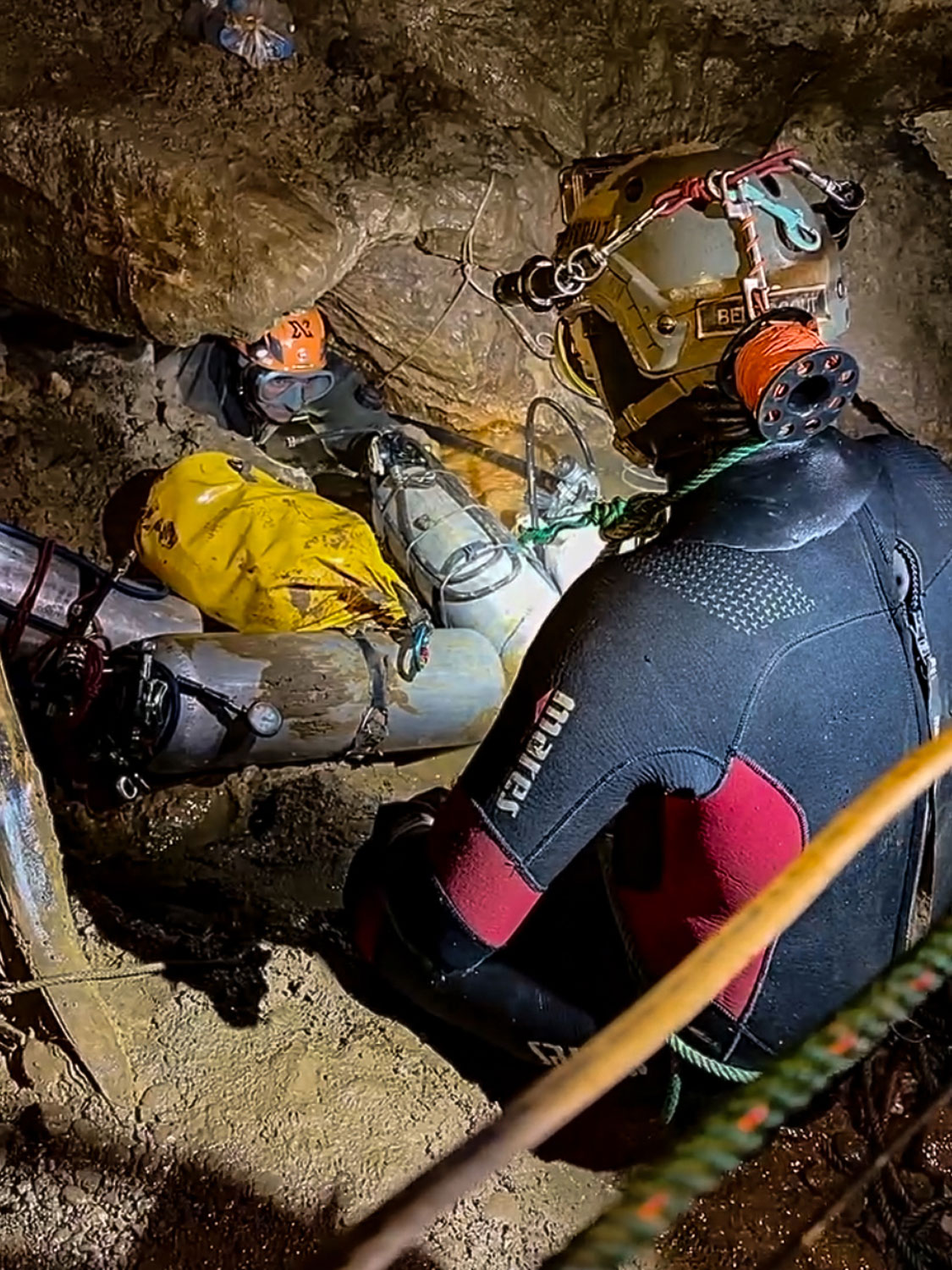
During the search and extraction we had to dive feet first without sidemount wing or fins as the restrictions were too small, complex and long. From left: Mikko Paasi, Norrased Palasing. Photo: Bottomline Projects archive Projects archives
The restriction seemed to absorb all sound and movement. There was no sense of distance, only the next handhold, the next movement and the awareness that we were committed to the passage. I had to keep communicating with him, keep him calm and keep checking that he was still responding by squeezing his hand from time to time. At the same time, I had to manage my own breathing and position, because there was no margin for getting stuck or losing my nerve.
We had obtained diplomatic immunity from the Thai-Lao Embassy for the whole team, but being responsible for a man’s life does not become easier because of any political protection you might have. One mistake and you are sentenced to a lifetime of guilt and nightmares.
The pressure was enormous. I was aware of the men still waiting in chamber five, of the team outside and of the fact that this first extraction would influence every decision that followed. We needed to prove that it was possible, but we could not allow that need to make us careless.
Slowly, we continued through the restriction.
When we finally reached the other side, the relief was immediate but incomplete. He was out of that section, but the operation was not over. We still had to move him through the remaining route and get him to safety. Only when he was outside could we allow ourselves to recognise what had happened.
He survived.
But that did not mean we had found a safe extraction method.
The second attempt
During the second attempt, the victim began coughing water and panicked. We had to stop.
Luckily, we were only a few metres into the passage, and I could still reverse us back to chamber five. That experience confirmed how dangerous it was to transport a conscious and distressed person through such restrictions.
If somebody became unconscious, there was almost nowhere to put them. You could not simply pick them up and carry them through passages where you could barely fit yourself.
A technique can work once and still be unsuitable as a standard rescue procedure.
After that second attempt, We decided we could not continue with diving extractions unless there was absolutely no other alternative.
7 days of pumping
While the diving options were being assessed, the pumping operation continued from 23rd May through 30th May.
For seven days, the team worked to position multiple pumps in different configurations and constantly maintained the hoses and connectors. It was hard, repetitive work in difficult conditions. Pumps failed, connections needed attention and the water level continued to respond to weather and equipment problems.
Then, finally, everything came together.
The pumps began doing their job.
The water level dropped on 30 May, if only for a few hours, but it dropped far enough for Plan A to work.
The remaining four escape
On 30 May, the remaining four men crawled out themselves.
They did not wait for us. They saw the opportunity and took it.
Suddenly, five people who had been trapped underground were outside and alive.
It was an incredible moment seeing the family members and friends, who have been waiting for ten days outside the mine, reconnecting and embracing each other.
But two men were still missing.
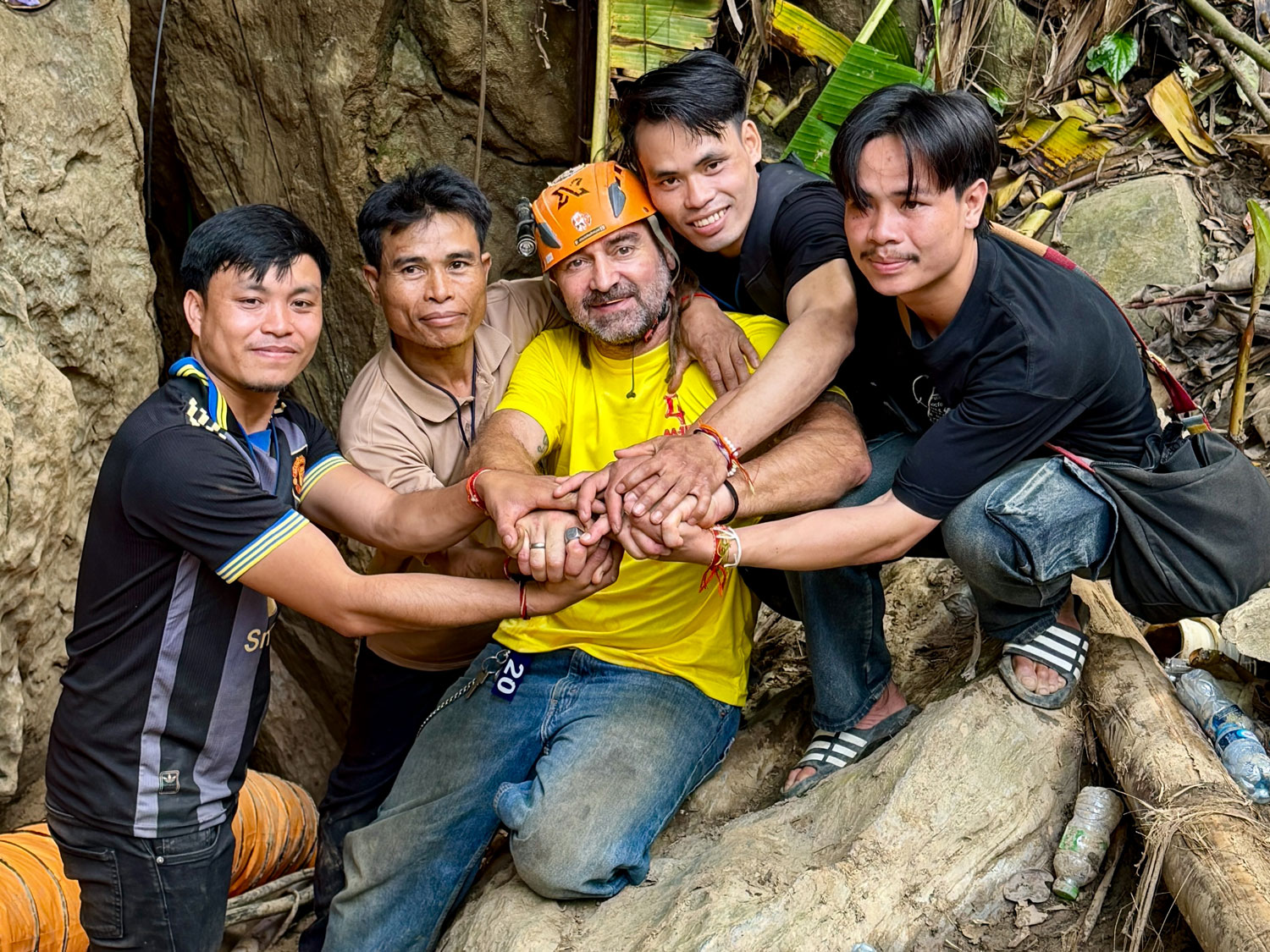
4/5 survivors and one rescuer (from left) Ee, Khamla, Mikko, Ing and Laen who all came to help us in the search of the missing two after being released from hospital. Photo: Bottomline Projects archive
The rescue became an exploration again
From 30 May onward, the five survivors had been found, but two other people who may have entered the system earlier remained unaccounted for.
Now we had to search.
As the person in charge the safety of our dive team, I realised the diving job was done: it was time to put the brakes on the underwater search and concentrate on the alternative entries that might lead to the chambers beyond chamber five.
This was where our exploration experience became essential. We crawled, climbed and carried pumps, pipes, communications equipment and other supplies through the system. We looked for alternative entrances, worked with Lao and Thai rescue teams and tried to understand the hydrology.
The next following week we spent up in the mountain locating potential alternative access to the mine. More help came when a Thai hydrology team led by Thanet Natisri finally got permission to join the search. I knew Thanet from the Thai cave rescue and he brought a cutting edge scanning technology TEM2Go with him that could see through lime stone and search potential passages.
We located multiple potential tunnels but they all were collapsed or the oxygen levels got too low to proceed. Whilst we were rappelling some 70m deep vertical shafts the other half was still working inside the mine.
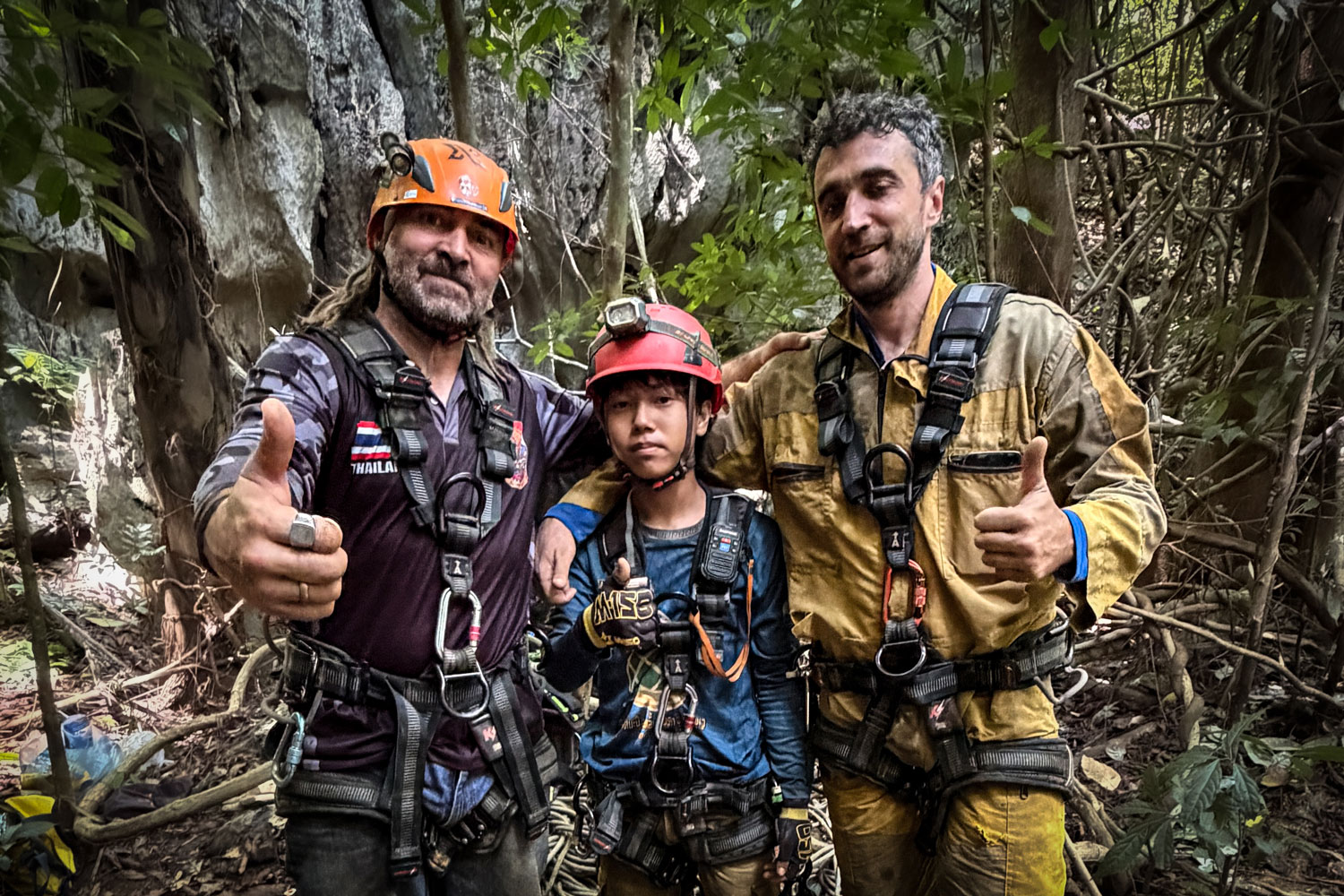
During the second week we rappelled some 50-70 metres deep vertical shafts looking for alternative entries. Khun Queue was always the first being the smallest, true hero at only 14 years of age. From left: Mikko Paasi, Toa Lek (Queue) and Robin Cuesta.
This had turned into extreme dry caving. Some passages were perhaps only 40 centimetres high. When water levels rose another 20 centimetres, somebody who had been crawling could suddenly be half underwater with only minutes to crawl to safety.
People panicked. People became hypoxic. Rescuers became unconscious. Pumps failed, rain and earthquakes came and sections collapsed.
Every time somebody entered, there was a possibility that we would create another rescue problem.
People wanted to help and push deeper, but sometimes the correct answer was:
No. We don’t go.
That was difficult.
It was also leadership.
Knowing when to stop
By 6 June, the conditions had become too dangerous. The weather was deteriorating, the cave was becoming less stable, air quality was worsening, water was rising and the collapse risk was increasing.
We still had no reliable indication that the two missing men were alive or where they might be.
For over two weeks we had already given everything we could.
At some point, you have to accept that you cannot fight nature. When somebody is missing, you always think there may be another passage, another entrance or one more dive that could make the difference.
But rescue has to have limits.
Otherwise, the rescuers become victims too.
The foundation for future rescues
The Laos rescue was not the result of one expedition or one training course. It was the result of years of connected work.
The timeline matters.
First came years of flooded-mine exploration in Thailand. That work taught us how to understand unstable, confined and potentially contaminated environments.
Then came the development of mine-diving training in Thailand. That helped turn individual experience into repeatable skills that could be taught, practised and evaluated.
After that came the three Laos expeditions. Those expeditions built local knowledge, relationships and trust. They gave us a connection to Alex and helped us understand how to work in Laos before an emergency occurred.
Then, in May 2026, the call came.
The rescue required people who could work in extreme restrictions, understand the hazards of an unfamiliar flooded system, adapt equipment and techniques and make difficult decisions under pressure. It also required local knowledge, logistics, communication and cooperation with the people already responding on the ground.
The Thai mines gave us practical experience. The training gave us a way to maintain and share that experience. The Laos expeditions gave us local relationships. The rescue brought all of those elements together.
We cannot wait until people are trapped underground to start building those skills and relationships.
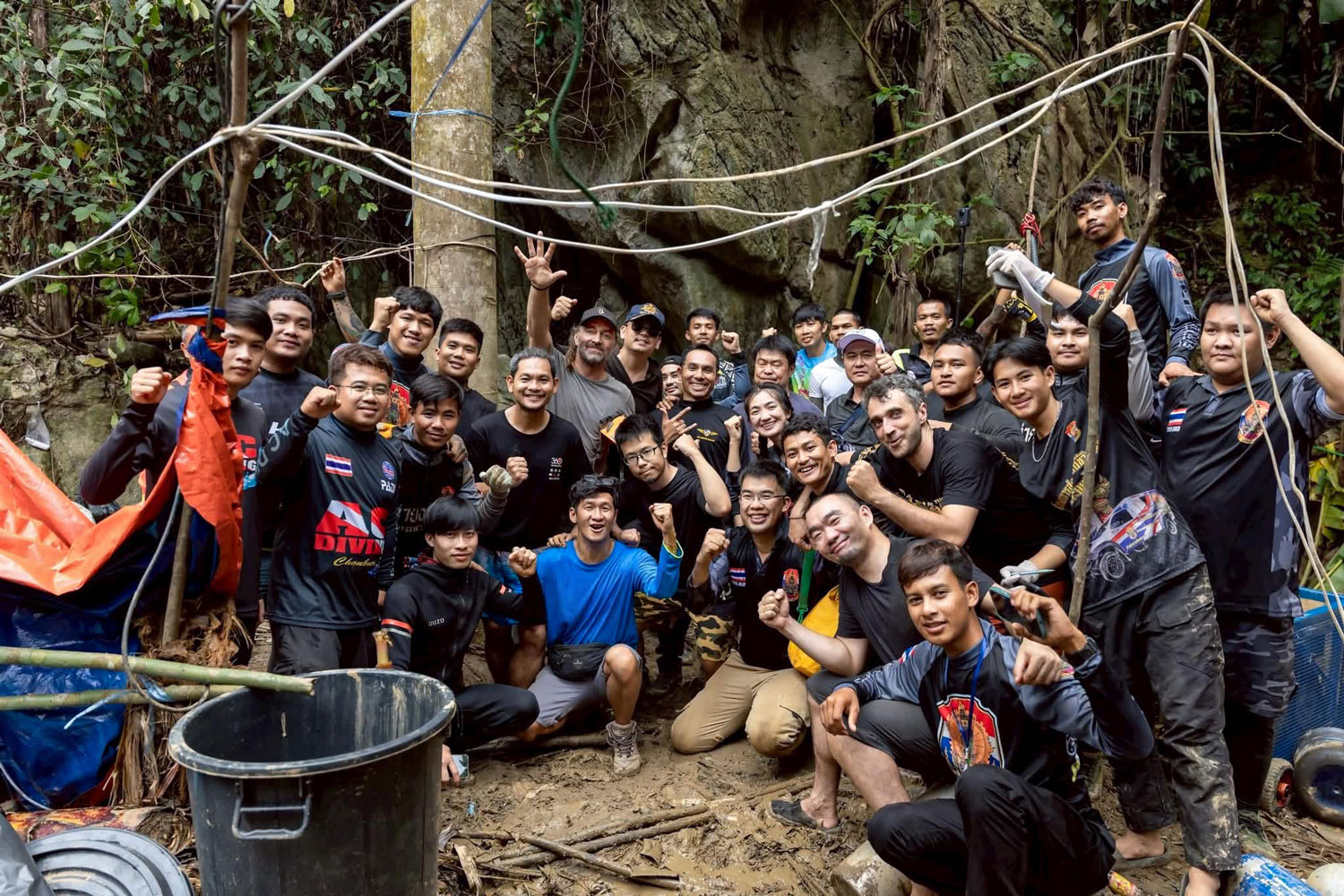
The united rescue teams from Laos, Thailand, Finland, Indonesia, Australia, France, Malaysia and Japan. Photo: Bottomline Projects archive
Keeping sites open for the future
There is one final lesson I hope we take from Laos.
If we want to maintain the ability to respond to future mine and cave accidents, we need places where specialist divers can continue to train, explore and develop their skills.
That does not mean every abandoned mine or cave should be open to unrestricted diving. Some sites are too unstable, contaminated, environmentally sensitive or dangerous to enter. Access must be responsible, assessed and managed, with appropriate permissions, conservation measures and safety procedures.
But closing every site, or allowing suitable sites to disappear through neglect, can have consequences beyond the loss of an exploration opportunity.
A flooded mine or cave becomes a valuable training environment when its hazards are understood, access is managed and divers can practise relevant skills under controlled conditions. Specialist rescue skills deteriorate if they are not practised. Teams need to maintain proficiency in equipment handling, guideline work, confined-space movement, communication, gas management, casualty assessment and the judgement required to decide when not to proceed.
They also need opportunities to work together before they are asked to do so in a real emergency.
A rescue team assembled for the first time during a crisis is already at a disadvantage.
We need suitable training sites, experienced instructors, local explorers and rescue specialists. We need to document underground environments, share knowledge responsibly and build relationships with landowners, authorities and local communities.
The objective is not to keep every mine open at any cost. It is to ensure that suitable environments remain available for responsible exploration and training, so the knowledge and skills needed for future rescues do not disappear.
The next call could come from another flooded mine in Thailand, a cave in Laos or a system nobody has properly explored yet. We cannot know where the next accident will happen.
But we can decide what we do before it happens.
We can keep training, explore responsibly, share knowledge and preserve the places that allow us to practise the skills that may one day save a life.
For me, that is the real bridge between exploration and rescue.
We explore to understand. We train so that we are ready. We maintain responsible access so future rescuers have somewhere to develop their skills. And when the call comes, we have a better chance of bringing people home.
If you would like to support Bottomline Projects NGO, your donation can help us continue exploring, documenting and protecting underground environments, developing specialist mine- and cave-rescue skills, supporting local communities and remaining ready to respond when future emergencies occur.

 BLOG