In 2025, DAN Europe saw a rise in dive accidents compared to 2024, while evacuation costs reached new levels. A few years ago, colleagues at DAN America alerted us to a worrying development: some hyperbaric chambers in the US had started refusing divers, increasing the distance an injured diver might have to travel to receive treatment. So, we wondered: Is there a general trend in hyperbaric chamber availability that could explain the rising number of complex and costly evacuations?
We dug into the data and real-life cases handled by DAN Europe case managers. What we found was less about a collapse in chamber access, and more about travel trends: scuba divers are increasingly drawn to remote dream destinations without always realising how “remote” they are in the event of a diving emergency requiring Hyperbaric Oxygen Therapy (HBOT).
As you will see, while hyperbaric chambers may appear to be available nearby on paper, the reality can be very different in remote diving destinations. The aim is not to discourage you from travelling to these extraordinary places, but to help you understand the situation more clearly and make the choices that put the odds in your favour.
Where do divers go and why?
When we look at the top 3 destinations for European divers, right now we have 1/Egypt, 2/Maldives, and 3/Indonesia. Marta Marrocco, DAN Europe director of assistance and claims services, confirmed that the coverage and availability of hyperbaric chambers in Egypt are satisfactory. The headaches her team is facing right now consistently come from Indonesia and the Maldives.
In 2025, there was an increase of 13% in cases handled by the DAN Europe hotline, and an increase of 4% in cases when a HBOT was necessary. Here is the breakdown for Indonesia and the Maldives:
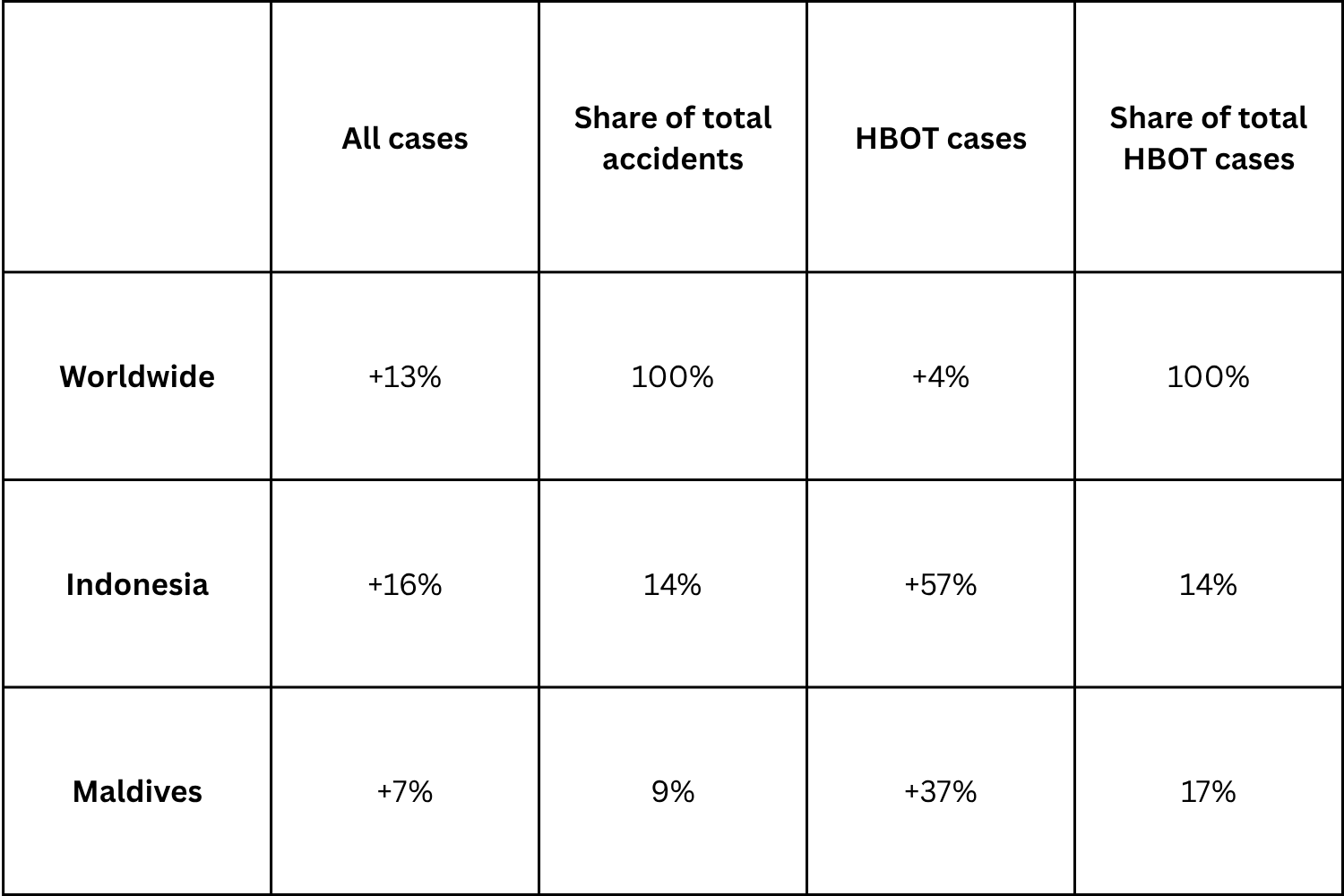
To compare apples to apples, it is worth noting that Indonesia received 15.4 million international arrivals in 2025, while the Maldives received 2.25 million.
Marta’s observations echo what we have noticed across the scuba diving industry: more divers are going further in search of the last underwater paradises. Is it an effect of overtourism? The impact of climate change with coral bleaching? Both? Well, obviously, tourists were told not to all crash in the same spots, and more and more got the message. Some of them may even have experienced first-hand the frustration of a diver soup over dead corals.
Social media has certainly amplified this trend. Content creators and businesses on social media rarely shy away from another exaggeration to land a viral activation of the algorithm: “last paradise on earth”, “shark sightings guaranteed”, or “manta ray storms”. And while it might marginally alleviate the situation in places like Sharm-el-Sheikh or Bali, it likely leads people travelling to places like Raja Ampat or Fuvahmulah while expecting similar levels of infrastructure.
All goes well until an emergency happens, and then reality catches up with you. The issue is not only whether a chamber exists, but whether it is operational, staffed, medically appropriate, and reachable in time. The Diver Alert Network currently lists 1400 hyperbaric chambers globally, but only about half have extended opening hours, trained staff for diving emergencies (hyperbaric chambers are also used for other types of injuries), and sufficient gas supply.
The point is not to alarm or scare you, but to help you understand the context and manage your expectations when diving somewhere in the middle of the ocean. As Marta Marrocco insists, “Fatal accidents after DCS are very rare. AGE (Arterial Gas Embolism) can lead to death, but AGE are even rarer. If AGE occurs, it doesn’t necessarily mean the diver will die. Out of all the emergencies we handle each year, 1,6% are fatal cases, and the majority of them are unexpected illnesses that occur underwater and lead to drowning. We estimate that 1 out of the 25 fatal cases we register is caused by AGE. »
Indonesia: evacuation cases from Raja Ampat to Alor
Indonesia is the largest country in Southeast Asia, spanning 5,100 km from Sumatra to Papua and encompassing 17,000 islands. Located in the Coral Triangle, it is home to some of the most sought-after dive spots on the planet. Who hasn’t heard about Bali, Komodo or Raja Ampat? But as these are becoming a bit too popular, scuba divers looking for a more pristine underwater playground are now learning the names of Alor, Banda Neira, and Togean, places that are often many hours, or even an air-ambulance flight, away from an operational hyperbaric chamber.
But as with most things in Indonesia’s scuba diving industry, everything revolves around Bali. And many diving emergencies, as far as Alor, end up with an evacuation to the island of the Gods. Today, Indonesia has 10 main hyperbaric chambers, and they are geographically rather well located, close to the most popular dive destinations: Saba (Gianyar) for Bali, Manado for Bunaken and Lembeh, Sorong for Raja Ampat, Labuan Bajo for Komodo, Mataram (Lombok) for the Gilis, and then there are Makassar and Jakarta.
Marta Marrocco gave us some valuable insights about the reality of DCI evacuations in Indonesia:
“For Raja Ampat, the situation has significantly improved recently with the opening of a hyperbaric unit of the hospital in Sorong, as the chamber in Waisai is almost non-operational for staffing reasons. However, this hyperbaric chamber does not accept patients 24/7. If a patient arrives at the hospital after 5.00 pm, they have to wait until the following morning to receive treatment.
Of course, it is best to treat the injured diver as soon as possible, but if the local chamber is available within the next 12 hours, it’s better to wait rather than arrange an air evacuation. When it happens, we arrange for the diver to spend the night in a hospital breathing oxygen. At the same time, our specialised team monitors the case remotely, often recommending the exact therapy to the local medical team.“
“Kasih Ibu Hospital in Saba, Bali, remains our first choice regarding hyperbaric oxygen therapy, considering their central location and excellent proven service“, says Marta Marrocco. With 24/7 availability and a central location, they are indeed often the number 1 choice in Indonesia. Still, they require the help of air ambulances if outside Bali (except for Lombok and the Gili Islands, which are just across the strait).
“When needed, we charter an air ambulance with a cabin pressure equivalent to sea level with nurses and doctors onboard (this is why it is expensive)“, adds Marta. Indeed, an injured diver with DCI cannot fly on a commercial flight.
In a huge country like Indonesia, flying from Alor to Bali can feel like going abroad for treatment. It is like flying from London to Madrid. But in a country prone to tropical cyclones and volcanic eruptions that scatter ash in the air, airport closures can occur. In all cases, DAN medical teams will follow up with the injured diver proactively. For information, DAN medical teams provide emergency assistance to all scuba divers, whether or not they are insured by DAN. The difference is whether the costs are covered by DAN insurance.
Talking about costs, Marta gave us two specific examples of air evacuations from the diving area of Alor. The amounts speak for themselves:
“From Alor last year, we had two cases of DCI that we had to evacuate to Bali. For the first one, from the moment the diver called us until the diver was in the chamber in Bali, approximately 24 hours passed. It cost 30,000 € for air evacuation (the total ended up being around 36,000 €).
The second one took 47 hours from the call to the chamber in Labuan Bajo and cost 23,500 €; the total cost of the case was around 35,000 €. This accident happened on a liveaboard, and the boat was in the middle of the sea.
They first headed to land to reach the closest medical facility for a first medical assessment, but the facility was very basic, and there was no airport nearby. They put the patient on oxygen, with close remote monitoring by our specialised medical team, and continued the navigation to Alor. It took them 12 hours to do so.
The supplier had some issues finding an airplane as the ones they owned were in use. On top of this, Bali airport was temporarily closed due to bad weather. The quickest solution was Labuan Bajo; otherwise, we would have had to wait an additional day to bring him to Bali. We chose the fastest option available. »
Since 2023, DAN has been investing and training professionals to strengthen the network in Indonesia, including the creation of a medical hotline in Indonesian to assist dive professionals across the country in their own language. The goal to train “1000 providers in 1000 days” was recently reached and celebrated in Labuan Bajo, the gateway to Komodo National Park.
Maldives: evacuation cases from Fuvahmulah to Addu
Despite being one of the most popular diving destinations in the world, the Maldives have only five hyperbaric chambers, a limited number considering the travel time between islands. Located in the Indian Ocean, the Maldives stretches over 823 km from Thuraakunu Island to the atoll of Addu with about 1,100 islands. While divers have traditionally concentrated in the central and northern atolls, more are now venturing into the deep south, especially to increasingly popular Fuvahmulah. However, when flying isn’t an option, it can take up to 10 hours for an injured diver in the Maldives’ southernmost atoll to reach the first hyperbaric chamber.
Once more, Marta gave us specific examples of evacuations from the south of the Maldives:
“Last year, we handled a severe neurological DCI case in Huvadhoo, and it took us 28 hours to get the diver to a hyperbaric chamber. In the meantime, the patient was treated at a local hospital and kept on oxygen. The difficulty is due not only to the actual distance but also to weather conditions, sea state, and the patient’s clinical status. That specific case ended up costing around 18,000 €, of which 6,000 € was for the speedboat transfer alone.”
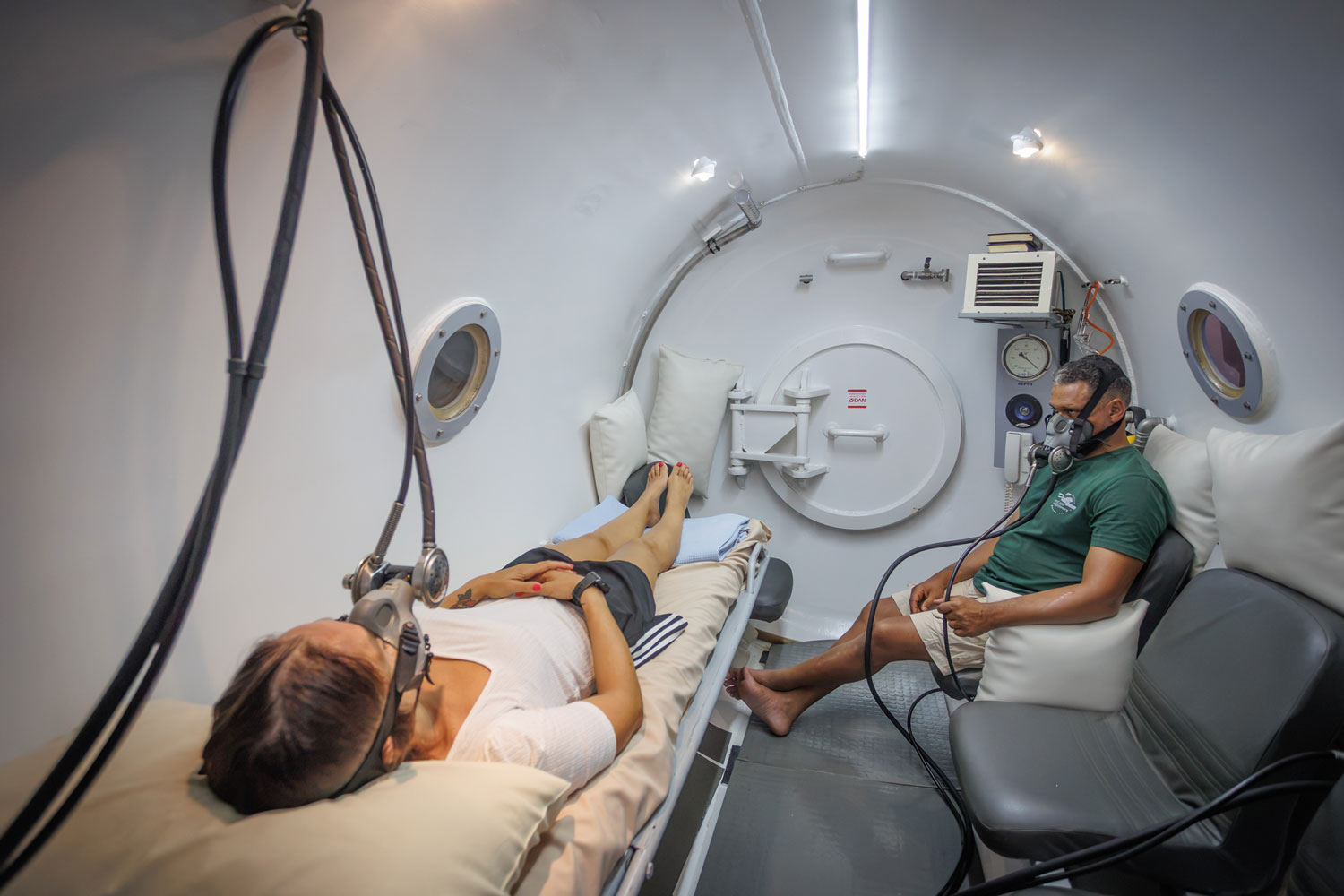
The additional challenge in the Maldives is that there is only one hyperbaric multi-place chamber (Kuredu Island, 122 nautical miles north of Malé). This type of hyperbaric chamber allows medical staff to accompany and assist the injured diver during HBOT. This alone can be critical in the event of certain medical complications.
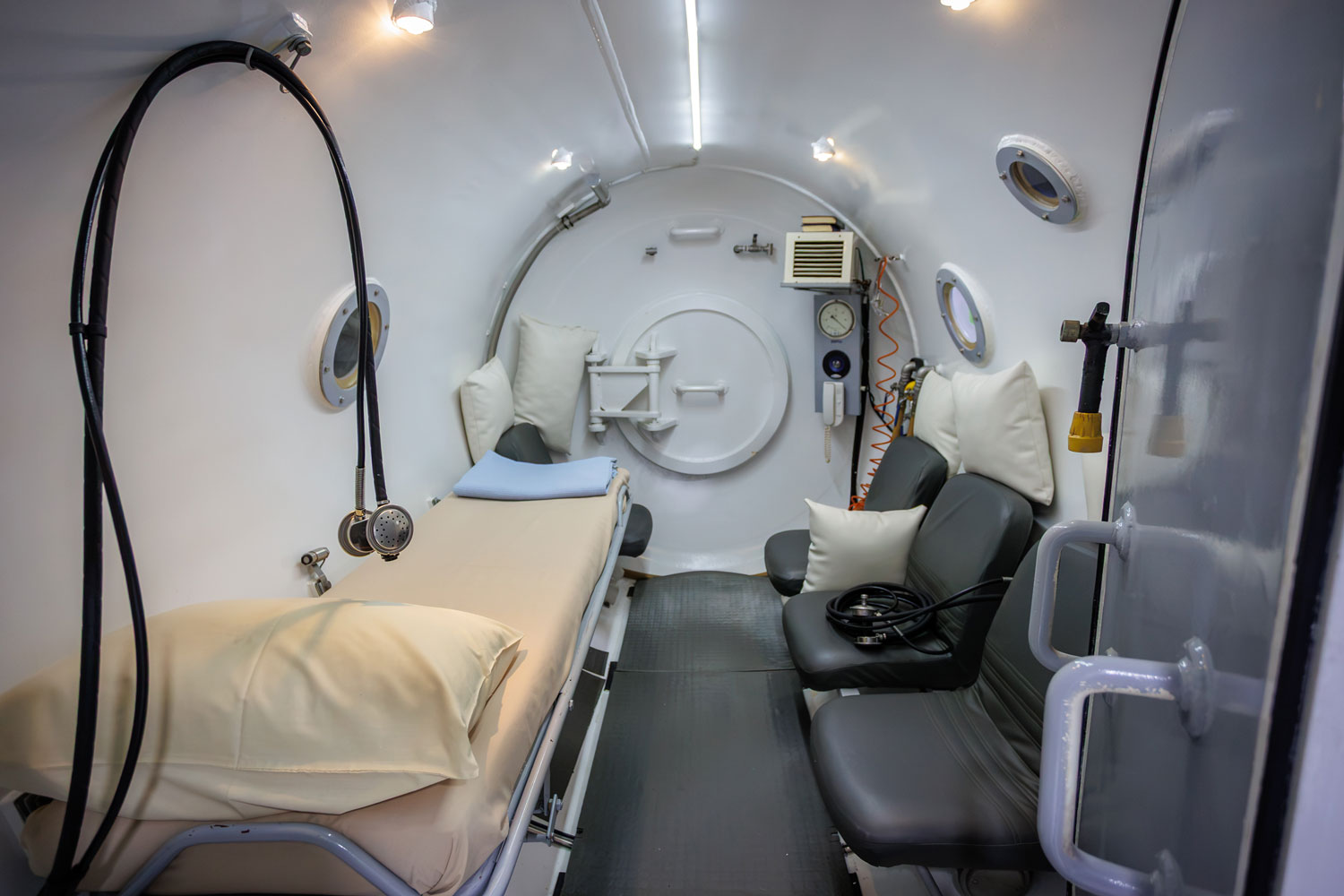
All the other chambers, including the new one at the ADK Hospital in Malé, are monoplace chambers. There is only one hyperbaric chamber in the southern part of the archipelago, on Kandima Island, about 120 nautical miles south of Malé. DAN Europe case managers also managed the case of an injured diver whose condition deteriorated while receiving HBOT in a monoplace chamber. Because the patient could not be assisted inside the chamber, the case unfortunately resulted in a fatality.
Air evacuation is not always a viable option, not only because of post-dive no-fly considerations but also because the existing Maldivian emergency air evacuation resources are, in practice, often unavailable when needed. Here is some data related to timing and costs for evacuations in the south:
- From Huvadhoo to Kandima, it takes on average 5 hours by speedboat, at a cost of around 5,000 €
- From Fuvahmulah to Kandima, it takes on average 8 hours by speedboat, at a cost of around 7,500 €
- From Addu to Kandima, it can take 10 hours by speedboat, at a cost of between 8,000 and 10,000 €
For the past 25 years, DAN Europe has built strong relationships with all stakeholders in the Maldives. In 2023, a DAN Europe delegation conducted an official visit across multiple atolls, meeting chamber operators, diving doctors, resort managers, and hospital administrators. All five hyperbaric facilities in the Maldives were assessed. DAN Europe offered collaborative training for government hospital staff on managing decompression illnesses.
What you must consider before booking your next diving holiday
DAN will always be there for you, no matter what, but we want our members and the rest of the diving community to keep in mind the realities of diving in remote places. We hope that, by seeing how complex evacuations can be, you will take action to better understand what your travel and diving insurance(s) cover. Besides, we would like to suggest divers add a few things to their to-do list as they pack their scuba diving gear:
Before booking your trip
- Check if the operator mentions any emergency plan, if they carry oxygen on boats and/or vehicles, and first aid kits, and maybe even an AED is available;
- Check your travel and diving insurance(s) conditions and exclusions;
- Research your destination to understand how remote it is; popularity doesn’t always equal infrastructure and accessibility.
During your diving trip
- Use and understand your dive computer (owning one is the best way to achieve this);
- Dive conservatively; 2 dives a day, always keep at least 5 minutes of NDL on your dive computer when doing recreational diving;
- Liveaboard trips usually run on 4 dives a day, take it easy, it’s ok to skip some dives if you feel tired (despite the high budget, don’t feel pressured by money);
- Do not delay reporting symptoms, contact DAN as soon as possible, and do not wait to see if you feel better in a couple of hours.

 BLOG
BLOG