BLOG
BLOGDiver Education Through the Ages: Equalization
An old training manual reveals how thought on this core skill has shifted.
19 December 2025
An old training manual reveals how thought on this core skill has shifted.
Once upon a time in the classroom of Tech Asia (Philippines), I came upon a little booklet of unambiguously antiquarian character: “Diving with the Aqua-Lung”, 11th edition, published by U.S. Divers in 1959.

The half-letter size booklet offers a fascinating glimpse into the early days of civilian scuba diving. It is a collage of Open Water Diver textbook, regulator maintenance manual, and guidance on setting up a filling station. It also has decompression tables, instructions on hookah diving, and even tips on how to start a dive club – all on a mere 40 pages of crisp, well-written prose.
Stylistic merits aside, “Diving with the Aqua-Lung” has some nuggets of information to offer, one of which I’d like to spend a little more time on. In the third paragraph of the introduction, the authors advertise diving with an Aqua-Lung as not requiring equalization – a bit of a surprise from a modern-day perspective, to say the least:

Lets have that again: “The ear-drums […] will remain in a neutral state” simply because we breathe air at ambient pressure? That is, no active equalization?
You read correctly. It is a description of what we refer to today as hands-free equalization, a technique considered quite advanced by modern standards, so advanced in fact that many scuba divers will never hear about it. Yet people took it for granted in the 1950s, ostensibly. Or did they? I’ll get back to that question in a bit.
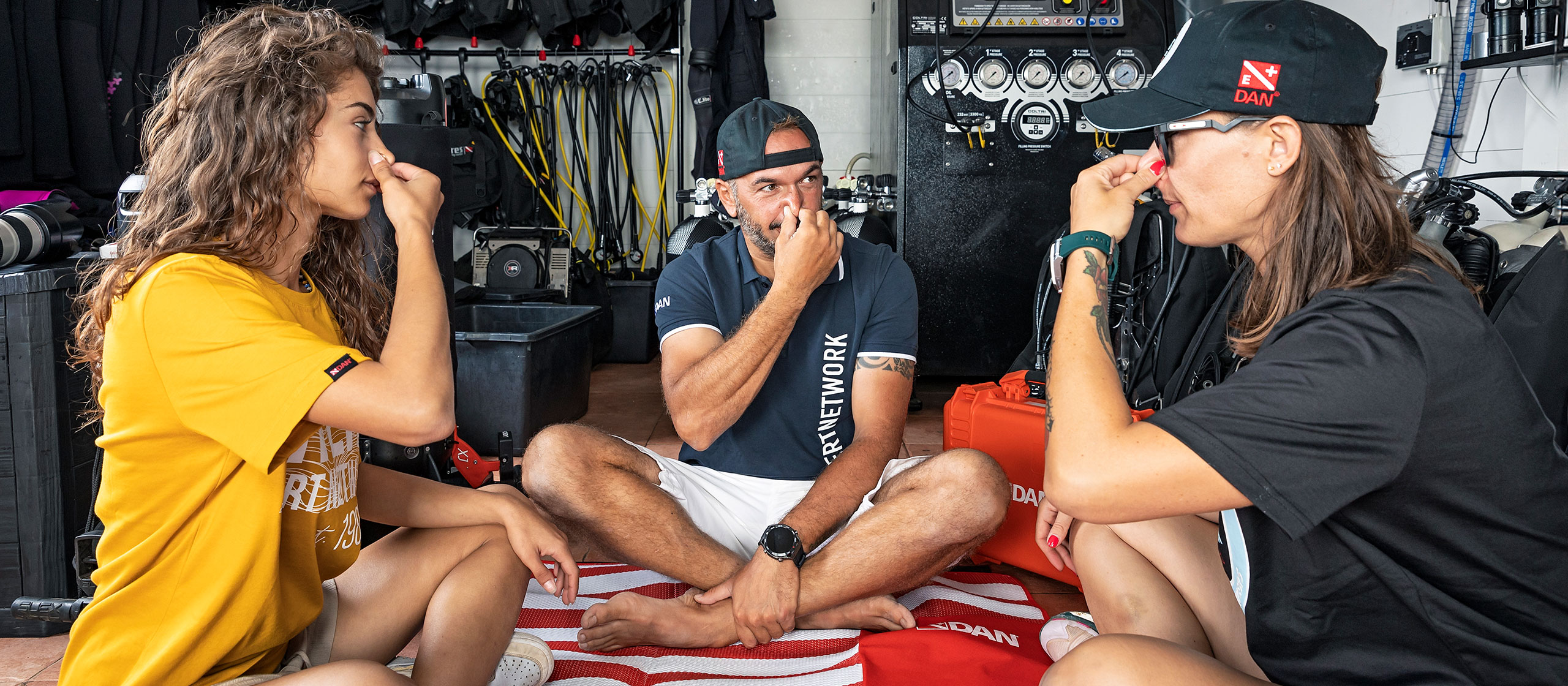
Most divers learn about equalization only once, during their Open Water Diver training. “Gently exhale against your pinched nostrils. Very gently. Do you feel your ears pop? Yes? You sure? Cool, you’re good to go.”
That’s what my OWD instruction was like, and I’m sure many will find it familiar. It works… kind of. Unless the instructor is quite careful, divers instructed in this way somewhat randomly end up performing one of two equalization techniques. The luckier ones instinctively close their glottis and use a swallowing action to pump air into the Eustachian tubes – the Frenzel maneuver. This is adequate, and the majority of divers, even instructors, never progress beyond this level.
The less lucky ones keep their glottis open and pump from the diaphragm – the Valsava maneuver. The diaphragm is a much stronger muscle and more difficult to control. As a result, Valsalva divers more frequently report ear pain after diving, and the risk of barotrauma is greater. Such divers generally remain unaware of the cause – equalization probably won’t come up in future training, and you need to know what you’re looking for to tell the difference as an outside observer.
With either of the above techniques, the textbook instruction is to equalize frequently during descent, at least every couple of meters. For a deep dive, that’s a lot of equalizing.
What if, instead of frequent, your equalization could be continuous? What if you could go all the way down to the bottom without touching your mask, and without feeling your ears? Welcome to hands-free equalization – the technique so casually alluded to in the introduction to our little booklet from sixty-six years ago.
The benefits of this technique are twofold: On one hand, your ears will experience virtually no pressure changes during descent. Even if you think that’s no big deal and Frenzel is fine, once you’ve learned hands-free, it’s like your neighbor’s kids finally turn off that gaming console they’ve been running all day long, to the point where you thought you’d stopped noticing the noise. You will notice when it stops and “your ear-drums […] remain in a neutral state.” It’s nice.
On the other hand, and this applies more to technical and CCR divers, you’ll have both of your hands free to signal during descent checks, operate your BCD, drysuit inflation valve, primary light, or whatever other part of your kit might need your attention. Or you could just relax.
Hands-free is a superior equalization technique, once you’ve mastered it, and herein lies the crux. All the involved musculature is internal. Instructors can’t demonstrate the technique to students, only describe it,* which makes this method much trickier to teach than the nose-pinching styles. I strongly suspect that’s why hands-free equalization isn’t mentioned in modern scuba training materials. Freediving… different story. Those people take equalization quite seriously.
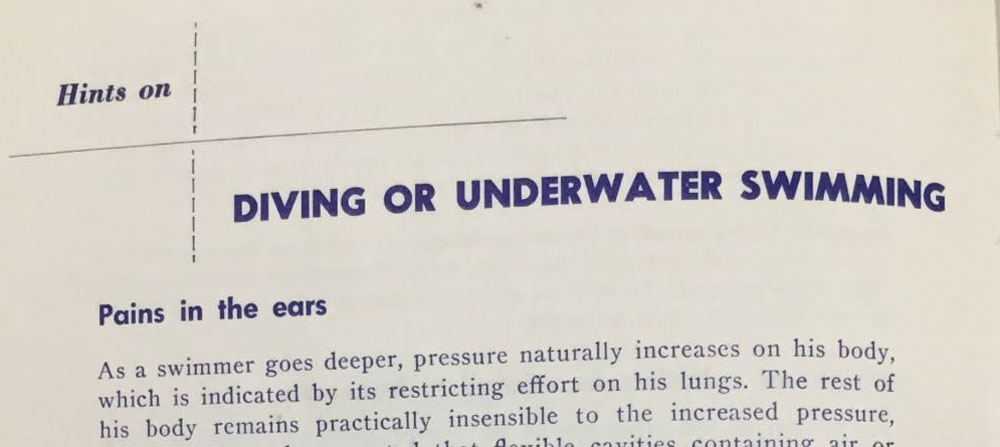
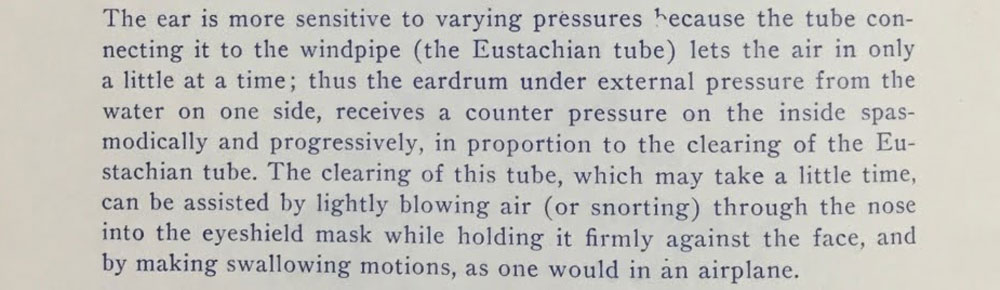
The booklet talks a little more about equalization in a section titled “Hints on Diving or Underwater Swimming”, subsection “Pains in the ears” (page 14). The authors explain how sinuses generally equalize by themselves, whereas the ears may take a little longer due to the small diameter of the Eustachian tubes.
They go on to describe two equalization techniques: (a) swallowing and (b) pressing the mask against the face and exhaling into it through the nose.** These techniques aren’t presented as essential, but merely as ancillary to a process that is taking place anyway. Nowhere in this booklet does it say, “as you descend, here’s how you equalize,” like modern training materials do.
Trying to come up with an explanation for why that is and how, I believe things become easier to understand if you consider what kind of person would have gotten into scuba diving in the 1950s. At the time, new scuba divers very likely would’ve been practiced skin divers (to use the period term) already. After all, why would you go and buy a scuba unit if you didn’t like diving? And if you like diving, then you obviously know how to equalize. Case closed. To this day, Open Water Diver courses include a legacy skin diving section to reflect this history.
Equalization is significantly harder on breathhold dives, especially when going deep. A competent skin diver experiencing the Aqua-Lung for the first time would’ve been surprised by the relative ease: All you need to do is to allow the pressure in your lungs to propagate to the eardrums. Piece of cake.***
Needless to say, this somewhat blasé attitude toward equalization didn’t last. Mask technology has changed to incorporate more sophisticated skirt designs with nose pockets, and along with it came changes to the way we teach equalization. As with most changes that stand the test of time, it must be assumed that these developments happened for good reason.
Today, beginner scuba courses need to accommodate the needs of people who don’t know how to equalize yet. With modern masks that allow for nose pinching, the Frenzel maneuver is safe, a lot easier to teach and execute reliably for beginners, and it gets people under water quicker – crucial when a course is scheduled to take three days because people have flights to catch on day four.
However, this doesn’t mean you have to remain at that level. Much like trim, buoyancy control, finning, and other personal dive skills, equalization can be improved beyond the minimum requirements for passing an open-water course. Let the Ancients be your guide and learn the hands-free technique. Your ears will thank you.
An earlier version of this article was published here on Tim Blömeke’s blog.
Further reading:
Alert Diver: Equaleasy, by Claudio Manao
Footnotes:
* The key to teaching hands-free equalization is finding a verbal instruction that makes students do the right thing with the muscles in their throats. I find that “pretend you’re suppressing a yawn” tends to work for a lot of people. Even so, it usually takes some time and experimentation. But believe me, it’s worth your while.
** 1950s dive masks had very thick, stiff skirts and no nose pockets. Pinching the nose from the outside was just not possible; pushing the mask against the face and increasing the pressure inside by exhaling through the nose was the next best thing. Search for “Charlie Sturgill mask” to learn about the gold standard of diving masks at the time.
*** My own first exposure to scuba diving was a bit like that. Our training as junior lifeguards in late 1980s West Germany involved lots of skin diving (albeit only Frenzel equalization, no hands-free). Every now and then, one of the instructors would bring a couple of scuba tanks to the pool to spice things up.
About the author

Dive into the latest stories,
before anyone else.
Subscribe to the
Alert Diver
newsletter.